


Qilin Ransomware: The Operation Powering Large-Scale Attacks in 2026
Executive Summary
Threat Profile
Group Overview
Qilin (also known as Agenda) was first observed in October 2022 and remains one of the most active ransomware groups as of 2026, with 1,669 confirmed victims globally. The group operates under a Ransomware-as-a-Service (RaaS) model, where core operators manage malware development and infrastructure while affiliates conduct intrusions. Qilin uses a double-extortion model, combining data exfiltration with system encryption, further reinforced by backup disruption and anti-forensic activity to increase operational pressure on victims, with recent activity highlighting an increasing reliance on advanced evasion and execution mechanisms including multi-stage payload delivery initiated through DLL side-loading, followed by memory-resident execution. These execution chains incorporate techniques such as Import Address Table (IAT) hooking, vectored exception handling (VEH), and syscall-based interactions to bypass user-mode security controls, with payload components loaded sequentially in memory to minimize disk artifacts and reduce forensic visibility throughout the attack lifecycle.
We already covered Qilin’s activity in the January 2026 report, where the group recorded 109 victims, making it the most active threat actor of the month and establishing its dominant position in early 2026. In the February 2026 report, Qilin maintained its leading position with 115 victims, reflecting a 5.5% increase in activity compared to January. In the March 2026 report, activity increased to 141 victims, representing a further 22.6% rise. This progression across three consecutive months demonstrates consistent expansion supported by an affiliate-driven model capable of sustaining high attack volume.
Operational Characteristics
Qilin’s operations begin with initial access through a combination of phishing, credential abuse, and exploitation of internet-facing services. Common entry points include VPN gateways, Citrix environments, exposed RDP services, and vulnerable enterprise systems such as Fortinet devices (CVE-2024-21762, CVE-2024-55591) and Veeam Backup & Replication (CVE-2023-27532). Affiliates also leverage identity-focused techniques including MFA fatigue attacks, SIM swapping, and abuse of remote management tools, enabling access through legitimate authentication channels rather than relying solely on traditional malware delivery. Following access, attackers establish control by extracting credentials and enumerating Active Directory environments to identify high-value systems, enabling lateral movement using native administrative protocols and tools such as PowerShell, PsExec, and WinRM, allowing activity to blend with normal operations.
In domain environments, propagation is scaled through mechanisms such as Group Policy-based deployment, enabling rapid distribution of ransomware across multiple systems. Execution follows a structured multi-stage approach, often initiated through DLL side-loading and progressing to in-memory payload staging to minimize disk artifacts. These execution chains incorporate techniques such as Import Address Table (IAT) hooking, vectored exception handling (VEH), and syscall-based interactions, enabling controlled execution flow and bypass of user-mode security controls while maintaining low visibility during runtime. Delayed execution and process manipulation further reduce the likelihood of detection during behavioral analysis.
Qilin demonstrates advanced defense evasion capabilities, including the use of Bring Your Own Vulnerable Driver (BYOVD) techniques to achieve kernel-level interference with endpoint protection mechanisms and disable security monitoring prior to payload deployment. Prior to encryption, data is staged and exfiltrated using tools such as Rclone, SMB channels, and cloud-based services, often originating from privileged systems to reduce detection. The ransomware payload, developed in Golang and Rust, supports high-speed encryption using algorithms such as AES-256 and ChaCha20, while attackers disable backup mechanisms, delete volume shadow copies, and clear system logs to prevent recovery and limit forensic visibility, ensuring maximum operational impact.
Victimology
Overview
Total Victims: 1,669
Countries Affected: 50+
Active Since: October 2022
Leak Site: Active
Qilin demonstrates a globally distributed victim base, with steady growth over time and a significant surge in activity during 2025, followed by sustained high operational tempo into 2026. The group’s victim distribution spans multiple economically significant regions, reflecting a combination of opportunistic targeting and scalable operations enabled by its affiliate-driven model.
Geographical Distribution
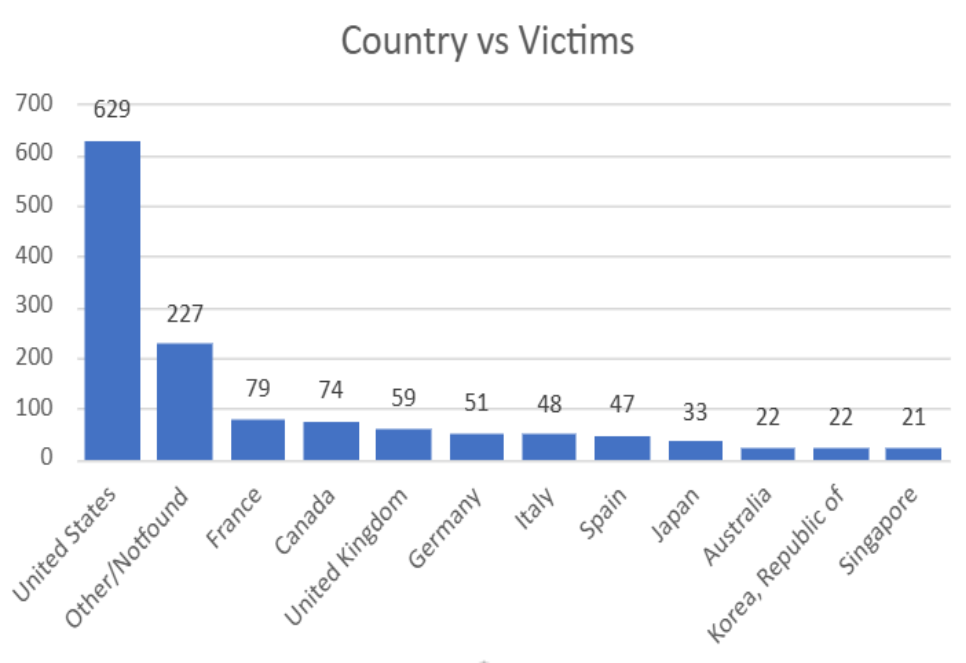
Qilin demonstrates a strongly global victim distribution spanning North America, Europe, and Asia-Pacific, with additional presence across the Middle East and Latin America. The United States accounts for the largest share with 629 confirmed victims, significantly exceeding all other countries and reflecting a focus on high-value targets and exposed enterprise infrastructure in mature economies. A substantial portion of victims (227 cases) remains without confirmed geographic attribution, indicating limitations in publicly disclosed or observable location data.
Across Europe, activity is widely distributed, including France (79), the United Kingdom (59), Germany (51), Italy (48), and Spain (47), highlighting consistent targeting of developed economies. In North America beyond the United States, Canada (74) represents a significant share of activity. In Asia-Pacific, Japan (33), Australia (22), South Korea (22), and Singapore (21) show steady exposure across the region.
Sector Targeting
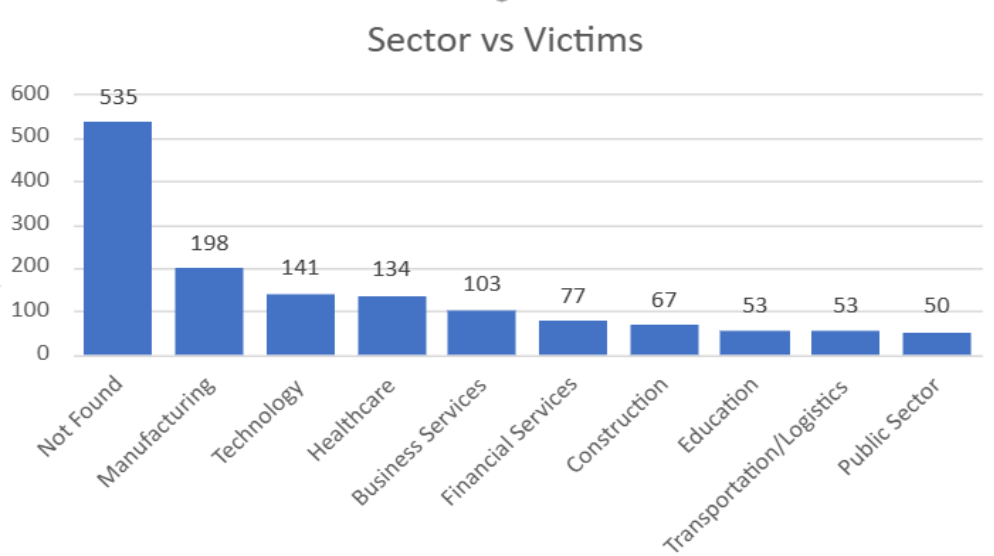
Among identified industries, Manufacturing leads with 198 confirmed victims, followed by Technology (141) and Healthcare (134), highlighting a clear concentration on operationally critical and data-sensitive sectors. Business Services (103) and Financial Services (77) also account for a substantial share, indicating continued focus on organizations handling high-value data and operating under regulatory constraints.
Other sectors, including Construction (67), Education (53), and Transportation/Logistics (53), demonstrate steady levels of activity, reflecting expansion beyond primary industry targets.A notable share of victims (535 cases) remains without confirmed sector classification, reflecting incomplete visibility into affected organizations.
Technical Analysis
Initial Access and Foothold
Qilin affiliates leverage multiple initial access vectors, primarily targeting exposed services and weak access controls. Common entry points include phishing-based credential theft, business email compromise (BEC), and exploitation of vulnerable public-facing applications. This includes exploitation of external access infrastructure such as VPN gateways and Citrix environments.
Secondary access vectors include the use of credentials obtained from infostealer data and initial access brokers (IABs), enabling direct access to enterprise environments. Attackers also exploit exposed services such as RDP, SMB, and WinRM, particularly in misconfigured environments, and abuse remote management tools such as NetSupport and ScreenConnect. In some cases, compromise of managed service providers (MSPs) enables indirect access into multiple downstream organizations.
Privilege Escalation, Defense Evasion, and Persistence
Following initial access, attackers perform internal reconnaissance to identify accessible systems and high-value targets, often leveraging network scanning techniques to map services and lateral movement paths. Privilege escalation is typically achieved through credential dumping using tools such as Mimikatz, allowing reuse of valid credentials across the environment.
Key techniques include:
Use of LOLBins (PowerShell, PsExec, WinRM) to execute commands and blend with legitimate system activity
Renaming of administrative tools (e.g., PsExec) to evade signature-based detection
Deployment of defense evasion tools (EDRSandBlast, PCHunter, YDArk) to disable or bypass endpoint protections
BYOVD techniques to gain elevated access and interfere with security controls
DLL side-loading for stealth execution of malicious payloads
Bypassing user-mode security controls through low-level system interactions and syscall-based execution
Use of memory-resident execution techniques to reduce disk artifacts and forensic visibility
Qilin activity also demonstrates structured multi-stage execution chains. Initial payload execution may begin through DLL side-loading, followed by in-memory staging of subsequent components. These stages incorporate delayed execution mechanisms and process manipulation techniques, enabling attackers to evade behavioral detection and sandbox analysis.
Advanced evasion techniques include manipulation of process execution flow through hooking mechanisms and controlled execution triggers, allowing payloads to activate under specific runtime conditions. The use of vulnerable drivers further enables kernel-level interference with endpoint protection systems, effectively disabling security monitoring before ransomware deployment.
Persistence is established through the creation of startup entries and scheduled execution mechanisms, ensuring continued access across system reboots while minimizing visibility to security controls.
Lateral Movement, Exfiltration, and Encryption
Lateral Movement Methods
RDP
SMB / PsExec
WinRM
PowerShell
RMM tools
Following compromise, attackers expand their access by reusing harvested credentials and leveraging trusted administrative protocols. Lateral movement is conducted through native Windows management channels, allowing execution of commands and payloads across multiple systems without introducing additional binaries that could trigger detection. Environments with exposed services, weak segmentation, or legacy configurations (e.g., NTLM-based authentication) enable rapid propagation.
Attack Sequence
Initial access and credential harvesting
Internal reconnaissance and service enumeration
Lateral movement across endpoints and servers
Data staging and compression within the environment
Data exfiltration using tools such as Rclone, SMB channels, and cloud-based transfer mechanisms
Deployment of ransomware payload
Execution of double extortion
Data is typically staged and compressed prior to exfiltration to ensure efficient transfer and reduce detection. Exfiltration is completed before encryption, ensuring attackers retain leverage through the threat of public data exposure.
Command and Control (C2) and Beaconing
Qilin-associated activity demonstrates structured command-and-control communication patterns, where infected hosts establish periodic outbound connections to attacker-controlled infrastructure. Beaconing behavior is typically observed at regular intervals with slight variations, enabling persistent communication while avoiding detection based on fixed timing patterns.
Malware components collect host-level information, including system identity and user context, and transmit this data to the C2 server. Commands received from the C2 are executed through system command interpreters, enabling remote task execution, payload deployment, and continued control of compromised systems in a looped execution model.
Encryption
Qilin supports multiple encryption modes, allowing affiliates to tailor execution based on operational requirements such as speed, stealth, and impact. The ransomware payload is typically deployed across compromised systems using remote execution mechanisms, with unique identifiers assigned per victim to manage execution.
Encryption is applied in a controlled and optimized manner, often targeting critical systems and data to maximize operational disruption while maintaining execution efficiency. This selective approach enables rapid impact without requiring full system encryption, increasing the likelihood of ransom payment while reducing dwell time during the final stage of the attack.
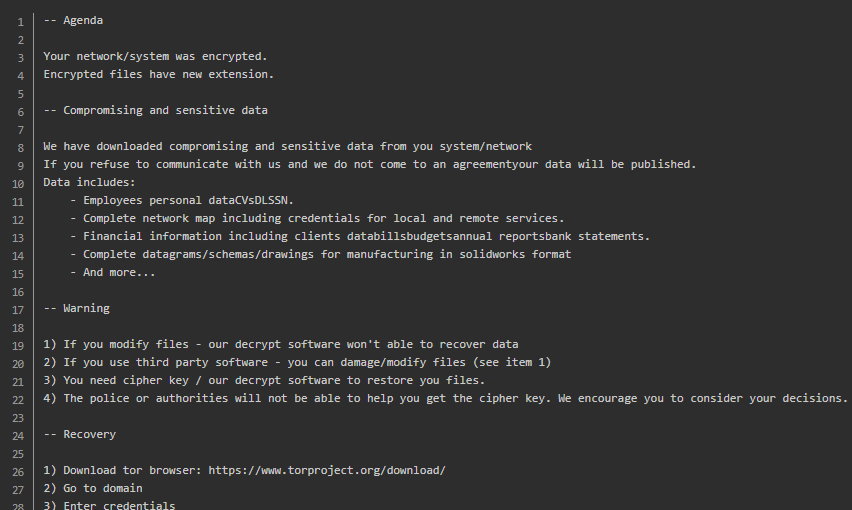
Ransom Note:
MITRE ATT&CK TTPs
|
Tactic |
Technique ID |
Technique Name |
|
Initial Access |
T1566 |
Phishing |
|
Initial Access |
T1078 |
Valid Accounts |
|
Initial Access |
T1190 |
Exploit Public-Facing Application |
|
Execution |
T1059.001 |
PowerShell |
|
Execution |
T1569.002 |
PsExec |
|
Execution |
T1219 |
Remote Access Software |
|
Persistence |
T1053 |
Scheduled Task / Job |
|
Persistence |
T1547 |
Boot or Logon Autostart Execution |
|
Defense Evasion |
T1562.001 |
Impair Defenses |
|
Defense Evasion |
T1574.002 |
DLL Side-Loading |
|
Defense Evasion |
T1036 |
Masquerading |
|
Defense Evasion |
T1211 |
Exploitation for Defense Evasion (BYOVD) |
|
Defense Evasion |
T1055 |
Process Injection |
|
Defense Evasion |
T1497 |
Virtualization / Sandbox Evasion |
|
Credential Access |
T1003 |
OS Credential Dumping |
|
Credential Access |
T1078 |
Valid Accounts |
|
Discovery |
T1046 |
Network Service Scanning |
|
Discovery |
T1087 |
Account Discovery |
|
Discovery |
T1082 |
System Information Discovery |
|
Lateral Movement |
T1021.001 |
Remote Desktop Protocol (RDP) |
|
Lateral Movement |
T1021.002 |
SMB / Windows Admin Shares |
|
Lateral Movement |
T1021.006 |
WinRM |
|
Command and Control |
T1071 |
Application Layer Protocol |
|
Command and Control |
T1090 |
Proxy |
|
Collection |
T1005 |
Data from Local System |
|
Collection |
T1074 |
Data Staged |
|
Exfiltration |
T1567 |
Exfiltration Over Web Services |
|
Exfiltration |
T1041 |
Exfiltration Over C2 Channel |
|
Impact |
T1486 |
Data Encrypted for Impact |
|
Impact |
T1490 |
Inhibit System Recovery |
Indicators of Compromise
|
URLs |
|
hxxp[://]45[.]221[.]64[.]245/mot/ |
|
hxxps[://]pub-959ff112c2eb41ce8f7b24e38c9b4f94[.]r2[.]dev/Google-Captcha-Continue-Latest-J-KL-3[.]html |
|
hxxps[://]chatgptitalia[.]net/ |
|
hxxp[://]185[.]141[.]216[.]127/tr[.]e |
|
hxxps[://]pub-2149a070e76f4ccabd67228f754768dc[.]r2[.]dev/I-Google-Captcha-Continue-Latest-27-L-1[.]html |
|
hxxp[://]104[.]164[.]55[.]7/231/means[.]d |
|
IPs |
|
176[.]113[.]115[.]97 |
|
176[.]113[.]115[.]209 |
|
85[.]209[.]11[.]49 |
|
31[.]41[.]244[.]100 |
|
188[.]119[.]66[.]189 |
|
MD5 Hashes |
|
291aa9f17d170ee9ca027c16d4acfaf9 |
|
34fe39190f861681e61a46fe8162d3bc |
|
dd475afd948cc22caa2a0f934d0aec52 |
|
0d68a310f4265821900249bec89364c2 |
|
d6e7547ad7dfd1fbc62e8282aebcc391 |
|
f588802958c35fe18eb87bc36651a3d1 |
|
2bb209ccfc5103eccab523c875050cfa |
|
a7e7d00d531cb7ca27d0f3bee448573f |
|
964c13b68dc6b6b918b66a9a10469d2a |
|
3b10127e65fa3e215d21e0a2e7fd32be |
|
d1c331c17ddd4abe0d53755461c1ec9a |
|
417ad60624345ef85e648038e18902ab |
|
b04e8ee43aba85fa5c585b9335c953c2 |
|
59d756280b06cf113ca43abc0050edd5 |
|
88bb86494cb9411a9692f9c8e67ed32c |
|
37155f0bca29ccd6b6d4f5b2bc42eb4d |
|
e01776ec67b9f1ae780c3e24ecc4bf06 |
|
11d795baafa44b73766e850d13b8e254 |
|
88630916b0c6633ca28c8896416a93ee |
|
dd42c3e017889c107a81da78d87dc8af |
|
1c4bea81c0da22badd9b7eab574c51cd |
|
ab05a1925fee8334a2114811d5283364 |
|
64a590760fdbb84356544cc90ac3d50f |
|
2020979e080d7ac9c0403172573c7de8 |
|
bed0f34673cc93560c17e3ab04ea5d19 |
|
4a3f22021e4415e8211633fb3735a046 |
|
6fc6164b3a08669992acad3764fb1922 |
|
d309e3d77ed6a336eb3ad263ddf9db90 |
|
575b26c1cc06609722f98e2beaed6a8a |
|
a6302fdb63e2244c1246a73a7d65d09e |
|
1bde76f3197123dcc2ecd0bfef567484 |
|
ea1f8794c73b26724314e5356f1f4128 |
|
9befad1d56d2bd8195813aea1f37f921 |
|
9f510626c7327a7c2328bc5131726638 |
|
08a2405cd32f044a69737e77454ee2da |
|
fdc6848dad660414bed9ad1b381cf6e3 |
|
19ff6488a259d750ec18902fe75a713b |
|
4ea8adecc5bd45a76cc61430c560924f |
|
53c8a4f0497929de4a5039b2c14bf426 |
|
670fe8faaede4e2e033311fb662d2a4a |
|
f982da00c547913fd0ae7d0da0fc77e7 |
|
9ea321b6a0f069caab7092cfe1cbbde0 |
|
2f76a29d4e4292d7f29a29345717812c |
|
826a8e8c05983aa3a884d7abcfa473ac |
|
8ca5c9745e8a0e18167a9b932821645a |
|
5862f9fc9c9a0d766eba29eb4945f619 |
|
3158a3849ea2695d6ec5aea6512fd030 |
|
24a8fcd08d9e40d32929b57de9b15385 |
|
996c394d0f6d6967df9542c52f6f4661 |
|
420a2c53386678396f972f09cc7f3a5c |
|
5cffa3126b9effc279d32b2cf4ef2278 |
|
348b0ce6af4698061678c8e92b4b2675 |
|
144183a4217ae0914ba0c865858d07cd |
|
6f893b1cc5cf534c59eabe932c1bf21e |
|
b4a6152514919a637c22a58bea316fc7 |
|
a7ab0969bf6641cd0c7228ae95f6d217 |
|
e4c1add9f7606e3fa57976b908b4b375 |
|
89ee7235906f7d12737679860264feaf |
|
6bc8e3505d9f51368ddf323acb6abc49 |
|
cf7cad39407d8cd93135be42b6bd258f |
|
SHA1 Hashes |
|
5cb0e22b625db7daa9690245d57989c21ab43b27 |
|
cb6d7a35e917322401558aed727289423f384876 |
|
6b6b34a001a3eee11d06a332faa49fbc080297b5 |
|
b8f756c90238be484f612ed882f2fd5592fe684b |
|
b5acea7aef6f88d891e7482fd883f0f81c72e924 |
|
b7bcf07871f1d072cd8e6307e637f35dea4ef91c |
|
6bc84c6f83dd43f5c66b800d9d44da718a134dae |
|
8bcaa69025e4f350ad585ea9ee2ab4d74feb1b29 |
|
6603445c83f6ddb95543c8a9c52325431137b865 |
|
073fe9f68e1be4726db769ccb1f6586fdf7cd46a |
|
bb36126ab418e11f8756f19d3b63aecc022743c1 |
|
a117b36dc901d95f2bb63937cc035e5046524448 |
|
6bb79f97d8e3fed7e430dc0806307b4cd3bc405e |
|
7543750b905175ce1ad18774852d945003cb9bde |
|
75d9b1db4f9b3c18114dcb56c8e7d7e6df9788df |
|
64fbbb7af0245129eac8f8261c8e70026db2f044 |
|
293036e908b3e400cd6e10bd2df86cfc5ca7f77a |
|
a628eb3f6e421b76b0c457b35c99fc16112975d6 |
|
61b0161a6f474825999df4c3f33a524366ee69e4 |
|
2ec5d4ddcd615643e289c91ba36c24d961282939 |
|
1b025dd08193012ba20f679bb41a72e2a6d43493 |
|
5568d9e73ae15943ec5da3b1356ed0d817b8d7e7 |
|
2a7a0f640b383436766be2b26f8c76af907e0c0b |
|
02344be3d34332785a680c5eb237ae7f4ce7ff89 |
|
9ce57316052a8719752fee6569fc1f4dc63f4471 |
|
d3fbba0085e1f0ac3aee8549a789d5e00eee5da3 |
|
3c3764bdf647edab0e1706ba44e9d5cd514ab4ce |
|
d104c1cdad3876264661d5134b0baf3c0df2a17e |
|
0711949aab58c1b051b388d89db388db2b047feb |
|
878b5dc93dcb0502a51ab191ff5a25c670bf7090 |
|
cf9d94705bbba2190cca7605cf89510b56fb6750 |
|
248d449a1d48616bf6ae7f9c2cadc474e95c7ace |
|
83c1e3c67ff93af12cc5a424f5a201f527dd5326 |
|
12c7a7465508e996e7b064ff8cfe983e38436194 |
|
b6b9ae6f1060a0be3bfea6f13c218df965ff983a |
|
51500ebb152cc6548204d96fbc65a10cfd96f4c9 |
|
bcebdb763cc740bea2765ac5358e66ba9828d93c |
|
cb77734eda7de79cd8ccedfb70f2a26c4c2847ad |
|
9e7376fb69cbeca4edd2397e5b54b8d972463dd0 |
|
e99c667e338dfeee60e7bd5c2c7848a351c67114 |
|
0f91f0ce8655665c85b42133e7f7c9c777048b6e |
|
a3700e915649c1cc12b72ea2a41ba894a0354aec |
|
c5b2e36ef6356757da4bbce417ca90f49d369526 |
|
7aa5a43d2fedf4a3abc8aea5847ca0ad6df8b92e |
|
9bac4d59b06239ac6e5cf124e3d8bb13a7145547 |
|
be50782fd91e3ac926d5f4f964853324624f2495 |
|
8cd8ffcba05ce144bd3b47a69d5003a9b7a58bcb |
|
461ee9cb48d94ba4080ed6c28a7676d5512f59a0 |
|
603f38559310eb36089845343eddd8b5baa853aa |
|
fa367a1f77acce946dd461df915535e9e5b80548 |
|
d322af1dd8739da274f4d9085ffcc2878d571de6 |
|
2981343bfd2db38e236c0b70c2a6cd924c49b0ab |
|
edd1be036b00de9a2a09a03d8e0e8ec392c5ee7b |
|
53fb91be6a6ccc4b18bb75f751263896fed1a640 |
|
acb42f17e865d05efdf26dee1efb1cd8fcde63b4 |
|
6be6ad3081593e466e533847f75723db3311c89c |
|
33fe6dc935c1b0df70761d05e26a00f8e5223087 |
|
9e06b7ce59d2004b02b46103d9132351e2e01b40 |
|
a15b95b7df68bb087427168e07c17f7b17379d56 |
|
31b754c4aff354e294b0a508ca2e0d4151060d53 |
|
01d00d3dd8bc8fd92dae9e04d0f076cb3158dc9c |
|
82ed942a52cdcf120a8919730e00ba37619661a3 |
|
ce1b9909cef820e5281618a7a0099a27a70643dc |
|
SHA256 Hashes |
|
7787da25451f5538766240f4a8a2846d0a589c59391e15f188aa077e8b888497 |
|
61f7aa918b55238278a1666cb723df9e3639d229d1027611e02ae3808ede33ed |
|
f910b2a6d84d0677cda9aefabfa4a45863ba51a8831588e3b527e8e1d3a9927c |
|
02835451193c2232094b591b7ef52a18786bae3232330839e63631f077f4946b |
|
033b4d28791b318fee5017e79c87c974ee621bae3b137d78ff11e2623ecf78a5 |
|
087216ee05746cc264752b0623dc6a1e32cddc0ca088832672e6dd356d394393 |
|
15e5bf0082fbb1036d39fc279293f0799f2ab5b2b0af47d9f3c3fdc4aa93de67 |
|
5f0253f959d65c45a11b7436301ee5a851266614f811c753231d684eb5083782 |
|
650a03c40c45eef3590058c37de8ea2e978c9c69f289390b2ab89be3910549fb |
|
381c3ed7a3b3d3017faaacb917c911aa266c2fb3e648f0e659222ec38148ee3c |
|
5b358f7cb6c2f16badbb476f7fa7515d4c142a1c1c47e22ab058155aa3120ba1 |
|
15249d8fcd6c59755622790123259c8a06a0a10d8ce4de66e394609cef2abb2b |
|
1455a215def8fe3c7053a21e748d20bcef586014b3d000b9f8e64be6ed99addd |
|
1e52d9f04f99be66d5bc13db767c6acb5f0515906633f76e5c713681af9454df |
|
5acd1ff8da9958a032cf63fb27d5e4b71c201612461e039f44eb07b2cc6735c0 |
|
a7f2a21c0cd5681eab30265432367cf4b649d2b340963a977e70a16738e955ac |
|
d628914c72a4294d6b67126eb8b5a08fa4974d05469852cb7ef872721b207498 |
|
363ab6b4c7f0e52d1242744fac16b26b66cd62fecffb27c5be2ca3644e1406f4 |
|
690d584bb489f5de42077147b13d5431ef3cd36e429a90fcdfe02bc97fdbec85 |
|
90bf9700d267b34aef7963ca51623daab9f4725253735a66e0a56c532f6b32c4 |
|
9983e9559790c6df67dc78157f65ee42320a9914c0b2cb7eb4b210e50266268c |
|
95bc5b0cf823d89f209035618f596f35267ba24401add2b2561ec795fbe9f1d6 |
|
147ad250400bb8c5ec2f7542afc82491fd23d665b070db03c17022ec969024a6 |
|
f52567ef22018ee7ef696ec1b28b99f019552827445425dd08e98195f6ac56fe |
|
44324ab4fcfcac9933670e8969e7ce334ed0d8139df6b6101c003d94480a9305 |
|
8410f85c1710bfefccf0517cbbc91c0019073ced28d66539eeb596a9de8be1a9 |
|
f17c9c6b1f1e4434e2688fc0d25d0bca1efb89582c03028f787fa2b9f765c17a |
|
db7b88dfbc16f4798b30c135a1e305d11b201ca3d9b600f2b2f3306f0ad32b18 |
|
c3fec6dd70f15fdf0683473539f1bde4c24e1aa25d97555c3d330f77b1edc3f1 |
|
340351639863a1c01eb0f8e34aafa2a5f36a7ee378c3cb112827ce3e9bfd7a87 |
|
96de53f71a914113dd1e0ab030b3e0707101af10bd6de3c894ee328d6f175e94 |
|
57e93d498dd91aebb7473950c12d8dc414aec39f6e3baa2a0b249649adf2ddc9 |
|
906f88817e3bf1bd4e800cf798650f3a309c81ee9b78c2a37d9118ce2567ae3d |
|
76dfbf622b6846653eff769e047efedc7a9fdbb00c939965d555da7aef460a5d |
|
78b6552fe4e7afbd21d8494dd19c056e16316b7aabdbaf746f5511a2dc2c542c |
|
a58adc18c13c4c357039ee5cf5fa5e886a7efc6026350cb7087466d667b87263 |
|
31c3574456573c89d444478772597db40f075e25c67b8de39926d2faa63ca1d8 |
|
6316417fcd979c39a4da672ba3521f62081ff4dfebb868ef65a1f2dff9a738ea |
|
16f83f056177c4ec24c7e99d01ca9d9d6713bd0497eeedb777a3ffefa99c97f0 |
|
bd1f381e5a3db22e88776b7873d4d2835e9a1ec620571d2b1da0c58f81c84a56 |
Mitigations & Recommendations
1. Initial Access Hardening
• Enforce multi-factor authentication (MFA) across VPN, Citrix, RDP, and cloud services
• Restrict exposure of external access services (RDP, SMB, WinRM)
• Implement advanced email security to detect phishing and BEC attempts
• Monitor credential exposure from infostealers and external leaks
• Apply strict controls on third-party and MSP access
2. Identity & Credential Protection
• Implement privileged access management (PAM) and least-privilege access
• Monitor credential usage for abnormal authentication patterns
• Enforce strong password policies and credential rotation
• Detect credential dumping and unauthorized reuse across systems
3. Lateral Movement Control & Network Security
• Segment networks to isolate critical assets
• Restrict and monitor use of PsExec, WinRM, and PowerShell
• Disable legacy protocols (e.g., NTLM where feasible)
• Monitor internal traffic for unauthorized lateral movement
• Detect internal scanning and service enumeration activity
• Limit administrative access to controlled management systems
4. Endpoint Protection & Defense Evasion Detection
• Deploy EDR/XDR with behavioral detection capabilities
• Monitor for misuse of LOLBins (PowerShell, PsExec)
• Detect renamed or obfuscated administrative tools
• Detect anomalies related to BYOVD and vulnerable driver activity
• Identify attempts to disable or tamper with security controls
• Detect abnormal DLL loading patterns and side-loading behavior
• Monitor syscall-level anomalies and user-mode hook bypass attempts
• Enforce application control and allowlisting policies
5. Persistence & System Integrity Monitoring
• Monitor creation of unauthorized scheduled tasks and startup entries
• Detect abnormal service creation and persistence mechanisms
• Track changes to registry keys and system configurations
• Identify long-term unauthorized access or dormant accounts
6. Command & Control (C2) Detection
• Monitor outbound traffic for beaconing patterns
• Detect connections to unknown or low-reputation domains
• Inspect encrypted traffic for anomalous behavior
• Implement DNS and network-level filtering controls
7. Data Exfiltration Prevention
• Monitor large outbound data transfers and abnormal compression activity
• Restrict unauthorized data transfer tools and cloud-based mechanisms
• Implement Data Loss Prevention (DLP) controls
• Inspect outbound traffic for staged or archived data movement
8. Backup & Recovery Strategy
• Maintain offline and immutable backups
• Regularly test backup restoration processes
• Protect backup systems from domain-level access
• Ensure separation between production and backup environments
9. Security Monitoring & Incident Response
• Integrate threat detection into SIEM and SOC workflows
• Conduct proactive threat hunting across identity, endpoint, and network layers
• Monitor early-stage compromise indicators across environments
• Detect multi-stage execution patterns and delayed payload activation
• Develop and maintain a ransomware-specific incident response plan
• Perform regular attack simulations and tabletop exercise
How CyberXtron Helps
• Xtron AI processes and correlates complex threat data into actionable intelligence, providing clear visibility into attacker activity and emerging risks. It supports faster, data-driven security decisions with reduced analysis effort
• Xtron MCP provides real-time, AI-driven interaction with threat intelligence, allowing teams to investigate, validate, and act on risks instantly. It streamlines response workflows and accelerates security operations
• ThreatBolt (Agentic AI–infused threat intelligence platform) delivers high-fidelity visibility into active threat campaigns, exploited vulnerabilities, and attacker activity. It positions organizations ahead of threats, enabling decisive action before compromise occurs
• DarkFlash provides continuous intelligence on leaked credentials, sensitive data exposure, and underground activity across deep and dark web sources. It equips organizations to shut down credential risks before they can be operationalized
• BrandSafe identifies and neutralizes phishing domains, impersonation attempts, and fraudulent digital assets targeting organizations. It actively suppresses external attack vectors and protects brand trust at scale
• ShadowSpot continuously maps and monitors the external attack surface to uncover exposed assets, misconfigurations, and security gaps. It enables organizations to eliminate exposure points before they become viable entry paths
Conclusion
Qilin has emerged as a highly active ransomware operation with sustained growth and consistent dominance across early 2026. The group’s affiliate-driven model enables large-scale operations, reflected in increasing monthly victim counts and a broad global footprint across multiple high-value sectors. Its targeting patterns demonstrate a balance between opportunistic access and deliberate focus on organizations where operational disruption and data exposure create strong financial pressure. Recent activity also reflects increasing operational sophistication, particularly in the integration of multi-stage execution techniques and memory-resident payload delivery designed to reduce detection during initial compromise and execution phases.
The group’s attack lifecycle is centered on exploiting exposed services, abusing valid credentials, and leveraging legitimate administrative tools to move across environments while remaining difficult to detect. The use of pre-encryption data exfiltration, backup disruption, and advanced evasion techniques—such as DLL side-loading, in-memory execution, and low-level system interaction to bypass security controls—further increases the overall impact of attacks and limits recovery options for affected organizations. These patterns highlight the need for strong identity security, controlled internal access, and continuous monitoring to detect early-stage activity and contain threats before they escalate.