

Ransomware Report - January 2026
Executive Summary
In January 2026, ransomware activity remained elevated, with a total of 702 reported victims worldwide, reflecting sustained pressure from established and emerging threat actors. Activity was dominated by groups such as Qilin, Akira, and Sinobi, while newer collectives such as The Gentlemen expanded their operational footprint.
Critical industries including Manufacturing, Technology, and Healthcare continued to experience heavy targeting, reinforcing attackers’ focus on operationally sensitive and data-rich environments. The United States remained the most impacted geography, accounting for the largest share of global victims.
At the same time, multiple threat groups demonstrated increased automation, faster attack cycles, and improved leak site operations. These developments indicate a continued maturation of ransomware-as-a-service (RaaS) ecosystems in early 2026.
Introduction
Welcome to the January 2026 Ransomware Report. This report provides an in-depth assessment of ransomware group activity, sectoral targeting, and geographic distribution observed during the month. It highlights emerging trends, major incidents, and evolving attacker strategies to support cybersecurity leaders and response teams in anticipating future threats.
Key Points
-
A total of 702 ransomware victims were recorded globally in January 2026.
-
Ransomware attacks increased by 13.6%, with victim count rising from 618 in January 2025 to 702 in January 2026.
-
Manufacturing (88), Technology (87), and Healthcare (43) were among the most targeted sectors.
-
The United States accounted for 281 victims, remaining the primary target region.
-
Qilin (109 victims), Akira (58), and Sinobi (56) led activity among threat groups.
-
Multiple emerging collectives expanded leak-site publishing and victim disclosure operations.
-
Increased operational tempo and automation characterized early-2026 ransomware campaigns.
Ransomware Activity – January 2026
Ransomware activity in January 2026 was led by Qilin, which recorded the highest victim count with 109 incidents, maintaining its position as the most active threat actor. Akira (58 victims) and Sinobi (56 victims) followed closely, reflecting sustained operational capacity and consistent targeting across multiple sectors.
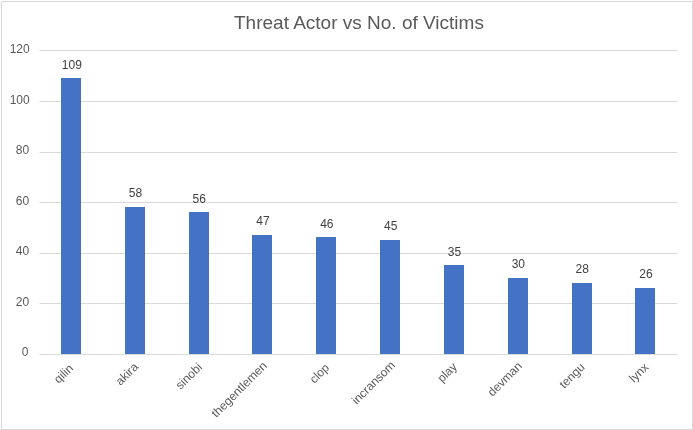
Mid-tier groups such as The Gentlemen (47 victims) and Clop (46 victims) also demonstrated strong activity levels, indicating continued expansion and stable affiliate participation. These actors collectively contributed to a significant portion of overall incidents during the month.
The distribution of victim counts highlights a concentrated threat landscape dominated by a small number of high-volume operators, supported by several steadily growing groups. This pattern reflects continued competition, operational maturity, and evolving campaign strategies among ransomware collectives in early 2026.
Ransomware Activity – January 2025 vs January 2026
Ransomware activity in January 2026 displayed significant shifts compared to January 2025, reflecting changing power dynamics among major threat actors. Qilin recorded the most dramatic rise, surging from 23 victims in January 2025 to 109 in January 2026, establishing itself as the dominant group of the month. Akira declined from 75 to 58 victims, yet remained among the most active operators, indicating sustained operational capacity despite increased competition.
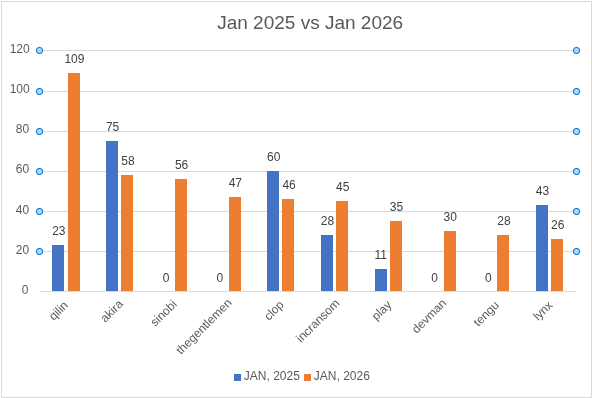
Notable declines were observed among previously prominent actors. Babuk2 (66 victims in 2025), RansomHub (43), and FunkSec (35) were largely absent from January 2026 data, indicating possible fragmentation, rebranding, or disruption. Similarly, Medusa dropped sharply from 22 incidents in 2025 to a single confirmed case in 2026, pointing to operational setbacks or shifting strategic priorities.
At the same time, several new or re-emerging groups gained visibility in 2026. Sinobi (56 victims) and The Gentlemen (47 victims) entered the top tier, while actors such as Devman, Tengu, and NightSpire expanded their footprint. These developments suggest continued affiliate migration and ecosystem restructuring as operators seek more profitable and resilient platforms.
Overall, the January 2026 ransomware landscape reflected intensified competition, rapid leadership changes, and ongoing volatility. The sharp rise of Qilin, the emergence of new dominant players, and the decline of former leaders highlight an ecosystem shaped by shifting alliances, evolving monetization strategies, and mounting defensive and legal pressures.
Industry Impact in January 2026 – Ransomware Hits Critical Sectors
In January 2026, ransomware attacks continued to concentrate on high-value and operationally essential industries.
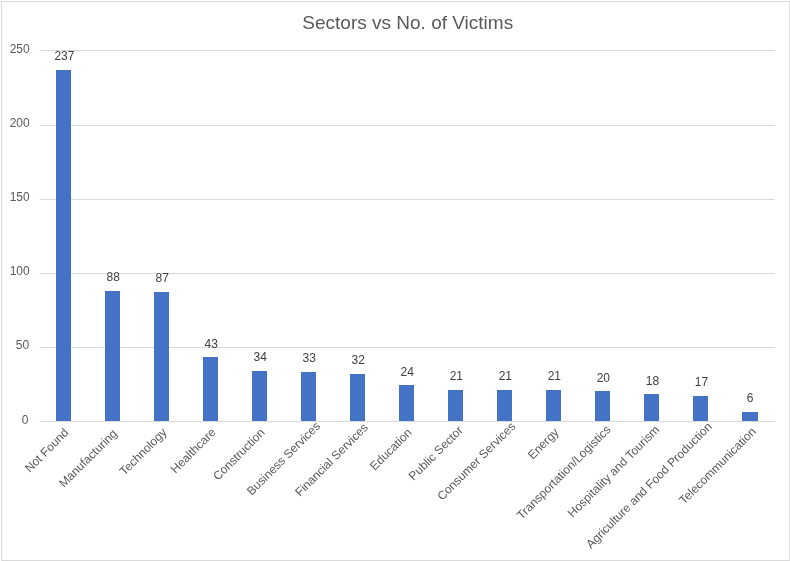
Manufacturing recorded the highest confirmed victim count (88), followed closely by Technology (87) and Healthcare (43). These sectors remain attractive targets due to production dependencies, regulatory exposure, and the high cost of downtime.
Construction, Business Services, and Financial Services also experienced notable disruption, while Public Sector and Education institutions remained persistent secondary targets. A significant proportion of incidents were categorized under “Not Found,” indicating incomplete sector attribution across underground reporting channels.
This distribution highlights attackers’ preference for industries where operational disruption directly translates into higher ransom leverage.
Geographical Distribution of Victims
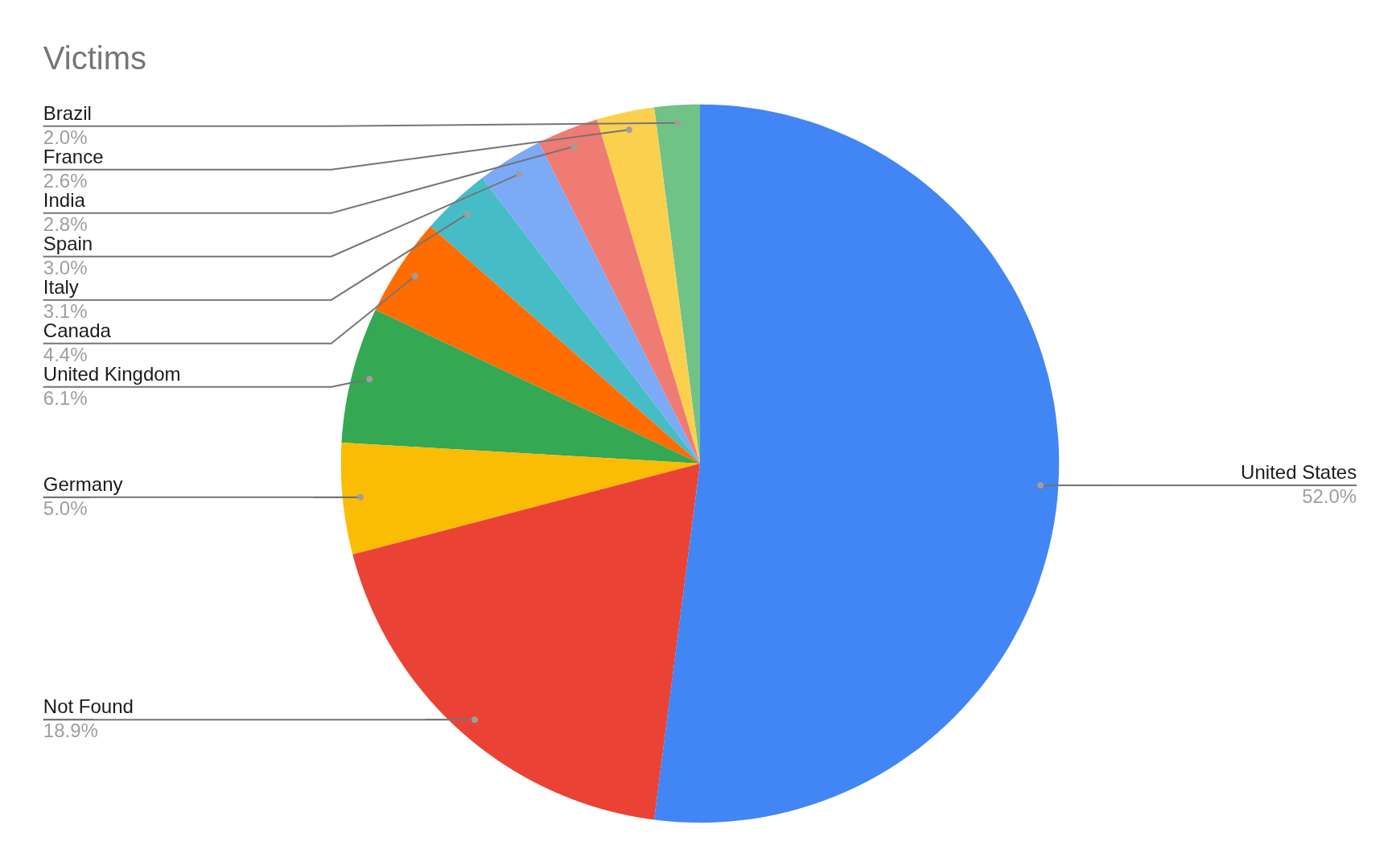
The United States remained the most targeted country in January 2026, accounting for the largest share of global victims. Developed economies continued to face disproportionate impact due to higher digital dependency and greater ransom payment capacity.
Western Europe also remained heavily targeted, particularly the United Kingdom and Germany. A notable portion of incidents was classified under “Not Found,” reflecting incomplete victim attribution in public disclosures.
Threat actors continued to prioritize regions with mature digital infrastructure and higher insurance coverage rates.
Major Ransomware Breaches Across Global Sectors – January 2026
During January 2026, multiple high-impact incidents were recorded across critical sectors:
- Qilin — Manufacturing & Industrial Operations (North America)
Qilin listed several manufacturing and logistics firms in the U.S. and Canada, claiming the theft of engineering designs and supplier records. Proof archives were published on its leak site, accompanied by staged disclosure threats. Sector: Manufacturing / Industrial logistics / Supply chain.
- Akira — Technology & Cloud Service Providers (Europe)
Akira targeted European technology providers, exfiltrating infrastructure documentation and customer databases. The campaign leveraged exposed VPN services and misconfigured backup systems. Sector: Technology / Cloud services / Managed IT.
- Sinobi — Enterprise & Digital Services (Multi-region)
Sinobi leaked source code repositories, internal communications, and customer support records from multiple digital service firms. Activity indicated exploitation of weak authentication and unsecured development environments. Sector: Technology / Digital services / Software development.
- The Gentlemen — Healthcare & Administrative Services
The Gentlemen breached healthcare and administrative providers, publishing scheduling systems, billing data, and employee records. The campaign relied primarily on phishing and abused remote access credentials. Sector: Healthcare / Medical administration / Support services.
- Clop — Construction & Infrastructure Services (Global)
Clop exploited vulnerabilities in third-party enterprise software to access construction and infrastructure firms. Stolen data included project documentation and contractor databases from multiple regions. Sector: Construction / Infrastructure / Enterprise software.
These incidents highlight attackers’ continued focus on data theft, supply-chain compromise, and reputational pressure to maximize extortion impact.
Conclusion
The ransomware landscape in January 2026 reflected continued operational maturity, expanding affiliate ecosystems, and sustained targeting of critical industries. Dominant groups such as Qilin maintained high-volume campaigns, while mid-tier actors demonstrated increasing technical sophistication.
The growing use of automation, modular toolkits, and cloud-based infrastructure continues to complicate detection and response. At the same time, accelerated leak-site operations and shortened negotiation windows indicate heightened psychological pressure on victims.
Organizations must recognize ransomware as a persistent, adaptive, and strategically driven threat that continues to evolve in scale and complexity.
Recommendations – January 2026 Ransomware Outlook
To mitigate evolving ransomware threats, organizations should adopt a layered and proactive cybersecurity approach. Based on current trends, the following actions are recommended:
-
Deploy advanced EDR/XDR solutions and continuously monitor for indicators of compromise.
-
Enforce rapid patch management for VPNs, cloud services, and exposed applications.
-
Implement strong MFA and least-privilege access controls.
-
Segment enterprise networks to limit lateral movement.
-
Maintain offline, encrypted, and regularly tested backup systems.
-
Conduct regular incident response and ransomware simulation exercises.