


Krybit Ransomware: Threat Profile of an Emerging RaaS Operation
Executive Summary
Krybit is an emerging ransomware-as-a-service (RaaS) operation observed since March 2026, with 41 victims across 25+ countries, demonstrating an early-stage but globally distributed presence. The group operates through an affiliate-driven, platform-based model and leverages identity-based intrusion techniques such as phishing, compromised credentials, and exposed services, followed by data exfiltration and multi-platform ransomware deployment across Windows, Linux, VMware ESXi, and NAS environments. Its structured affiliate ecosystem, including centralized victim management and leak workflows, indicates a scalable operational design; however, several advanced capabilities remain self-reported, and gaps in attribution limit full visibility into its scale.
Key Insights
- Krybit is an affiliate-driven RaaS group with 41 victims across 25+ countries, indicating early but globally distributed activity.
- Initial access is primarily identity-based, leveraging phishing, compromised credentials, and exposed services.
- The group follows a structured double extortion model with data exfiltration and multi-platform ransomware deployment across Windows, Linux, VMware ESXi, and NAS environments.
- Krybit advertises SaaS-like capabilities through a platform-driven ecosystem, though several advanced features remain unverified and self-reported.
- Victim distribution is opportunistic, with no clear sector or geographic focus, reflecting accessibility-driven targeting and emerging operational capability.
Threat Profile
Group Overview
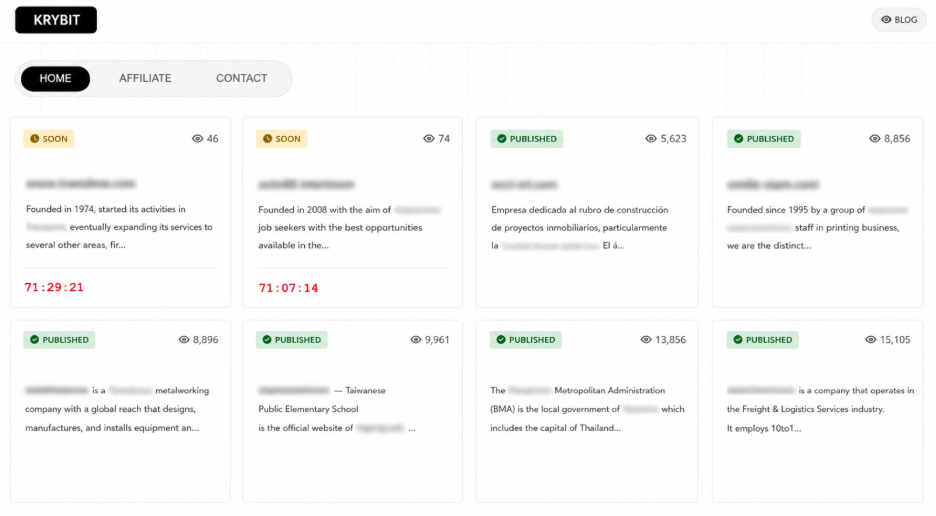
Krybit is a newly emerged ransomware operation observed since March 2026, operating under a Ransomware-as-a-Service (RaaS) model. The group has established an operational presence with 41 identified victims across 25+ countries, reflecting a globally distributed but limited footprint. Krybit employs a double extortion strategy, combining data exfiltration with system encryption, and maintains a Tor-based data leak site (DLS) to pressure victims into ransom payments. Victim and sector distribution indicate an opportunistic targeting model, impacting organizations with varying levels of security maturity rather than a clearly defined size- or industry-specific focus.
Operational visibility into Krybit’s infrastructure reveals a platform-driven affiliate ecosystem, supported by a centralized panel that enables victim management, staged leak publication (e.g., “published” / “soon”), and integrated data handling via external services such as MEGA, SFTP, PIXELDRAIN, and STORJ. The affiliate model is reinforced through a defined revenue-sharing structure (~80% affiliate / 20% operator), along with features including dedicated dashboards, team management, TOX-based communication, and continuous operational support. These elements indicate a structured and scalable operational design; however, several advanced capabilities remain self-reported and not independently validated, reflecting an evolving but not fully verified technical maturity.
Krybit has also demonstrated the ability to conduct offensive actions against another threat actor (0APT), including compromising its infrastructure, accessing internal data, and disrupting its data leak operations. This interaction provides direct evidence of capability beyond standard ransomware deployment. While initially assessed as a low-to-mid maturity threat actor, current observations indicate a transition toward a more structured and scalable operation, though gaps in tooling transparency, consistency, and technical depth suggest that Krybit remains an evolving threat requiring continued monitoring.
Operational Characteristics
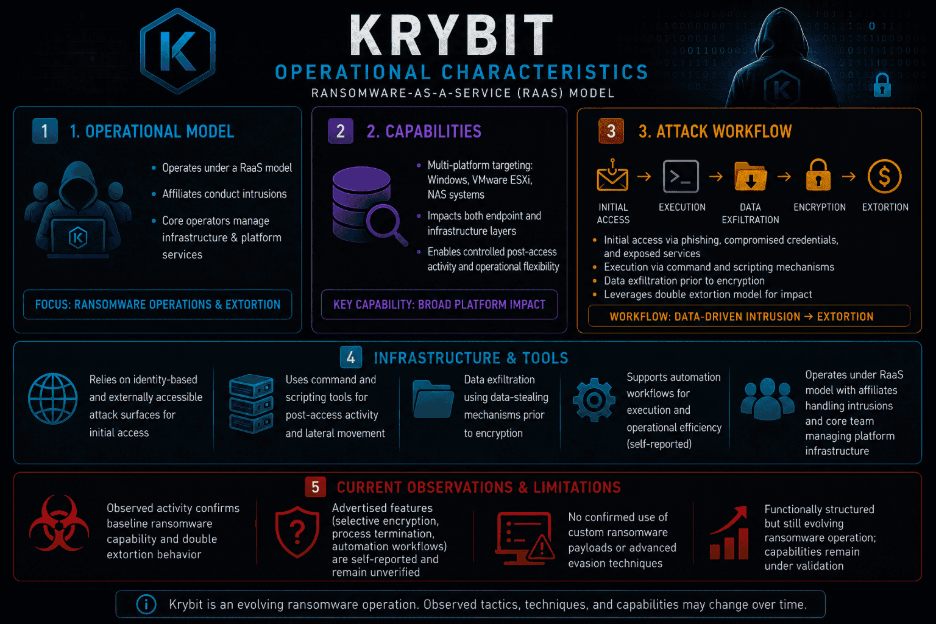
Krybit operates through a structured ransomware lifecycle aligned with a Ransomware-as-a-Service (RaaS) model, where affiliates conduct intrusions while core operators maintain infrastructure and platform services.
Victimology
Overview
|
Metric |
Value |
|
Total Victims |
41 |
|
Countries Affected |
25 + |
|
Active Since |
March 2026 |
|
Leak Site |
Active |
Krybit demonstrates a globally distributed but relatively low-density victim base, consistent with an early-stage ransomware operation. The group’s activity spans multiple regions without a dominant geographic concentration, indicating an opportunistic targeting model driven by accessibility rather than strategic regional focus. A small portion of victims falls under Unknown / Other (2 cases), highlighting minor attribution gaps rather than widespread visibility issues.
Despite its limited scale compared to established ransomware groups, the distribution of victims across multiple countries and sectors reflects a functional and expanding operational footprint. Supported by its affiliate-driven RaaS model, this pattern indicates scalability without reliance on highly targeted campaigns. The absence of clustering in high-value regions reinforces Krybit’s prioritization of ease of compromise over strategic targeting, aligning with its current stage of operational development.
Geographical Distribution
Krybit exhibits a globally distributed victim footprint across Europe, Asia-Pacific, Africa, and the Americas, with no clear regional dominance. Unlike earlier assumptions, unknown/other is minimal (2 cases), indicating relatively clear geographic visibility across most victims.
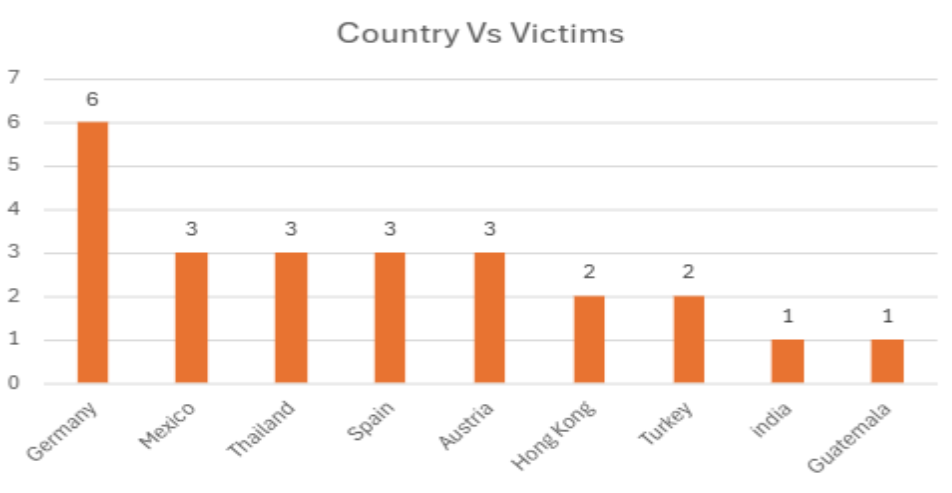
Among identified countries, Germany (6 victims) represents the largest share, followed by Mexico, Thailand, Spain, and Austria (3 victims each). Turkey and Hong Kong (2 victims each) show moderate activity, while the remaining countries — including Guatemala, India, Italy, Taiwan, France, Singapore, United States, Dominican Republic, Kenya, Zambia, United Kingdom, Brazil, New Zealand, Romania, South Africa, Botswana, and Japan (1 victim each) — reflect highly dispersed and low-frequency targeting.
Regionally, Europe shows the highest concentration but remains fragmented, with activity spread across multiple countries rather than focused campaigns. Asia-Pacific demonstrates consistent but low-volume exposure, while Africa and the Americas show sporadic targeting across diverse locations. This distribution reinforces an accessibility-driven targeting model, where victim selection is influenced by exposure and security posture rather than geographic or economic prioritization. The absence of concentration in high-value regions further differentiates Krybit from more mature ransomware groups, which typically demonstrate focused targeting across strategically significant geographies.
Sector Targeting
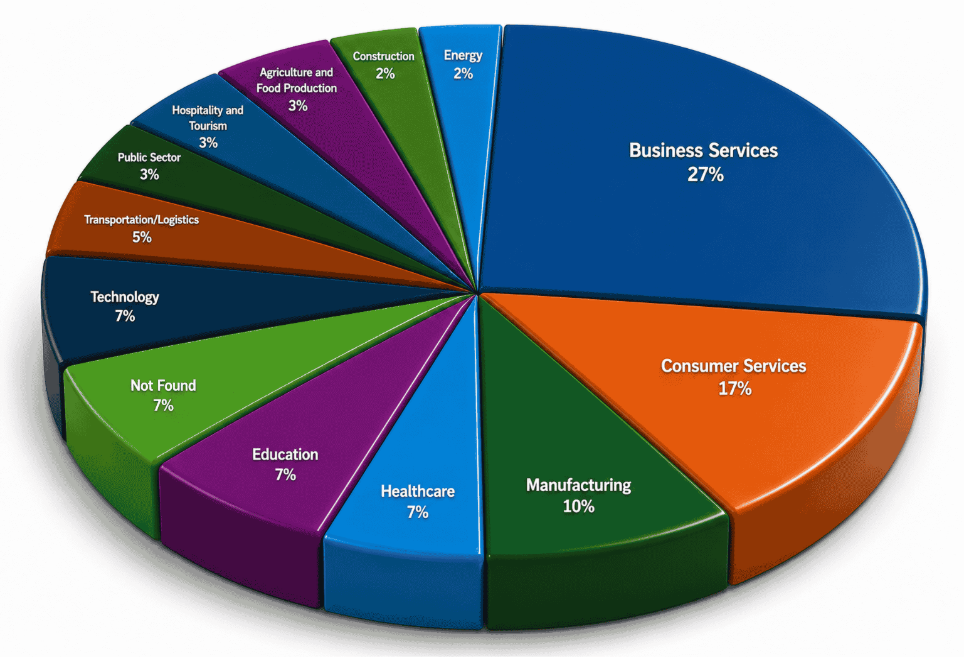
Krybit’s sector distribution reflects a broad and opportunistic targeting approach, with no strong concentration on highly regulated or traditionally high-value industries. Business Services (27%) represents the largest share, followed by Consumer Services (17%), indicating a preference toward service-oriented organizations that often operate in distributed environments with variable security maturity.
Manufacturing (10%) shows moderate targeting, while Technology, Healthcare, Education, and Not Found / Other (7% each) indicate consistent exposure across both operational and data-centric sectors. This distribution highlights a balanced spread across industries rather than concentration in specific high-value verticals.
Other sectors — including Transportation & Logistics (5%), Public Sector, Hospitality, and Agriculture (3% each), and Construction and Energy (2% each) — reflect lower-frequency targeting. Overall, the distribution aligns with an opportunistic and accessibility-driven targeting model, rather than a strategically defined sector-focused campaign.
Technical Analysis
Initial Access and Foothold
- Available intelligence indicates that Krybit gains initial access primarily through phishing, compromised credentials, and exposed services, reflecting a reliance on identity-based intrusion and externally accessible attack surfaces. These approaches enable attackers to operate within legitimate authentication contexts, reducing detection likelihood and bypassing traditional perimeter defenses.
- There is currently no confirmed evidence of vulnerability exploitation or advanced intrusion techniques. Krybit’s access strategy remains largely credential- and exposure-driven, with further developments under observation as additional activity is identified.
Privilege Escalation, Defense Evasion, and Persistence
- Krybit demonstrates the use of command and scripting-based execution, enabling controlled activity within compromised environments. Observed use of obfuscation techniques suggests an effort to evade detection and bypass basic security controls.
- Techniques related to privilege escalation and persistence remain unconfirmed, with no consistent tooling or repeatable patterns publicly documented. These stages continue to lack sufficient visibility and remain under observation.
Lateral Movement, Exfiltration, and Encryption
Lateral Movement
- Lateral movement techniques are not clearly defined, with no confirmed tooling or standardized methods observed. Internal propagation behavior remains under analysis and may vary depending on the compromised environment.
Attack Sequence
- Initial access via phishing, exposed services, or compromised accounts
- Execution through command and scripting mechanisms
- Internal reconnaissance and data staging
- Data exfiltration to attacker-controlled infrastructure
- Deployment of ransomware payload
- Execution of double extortion
Data exfiltration is performed prior to encryption, supporting Krybit’s double extortion model. While the group advertises advanced capabilities such as selective encryption and automated workflows via its affiliate platform, these features remain self-reported and unverified.
Command and Control (C2)
- Available intelligence indicates the use of attacker-controlled infrastructure for data exfiltration and operational coordination, implying the presence of command-and-control (C2) communication.
- Detailed characteristics — including protocol usage, beaconing behavior, and infrastructure design — remain under observation, with limited visibility into overall C2 sophistication.
Communication Analysis
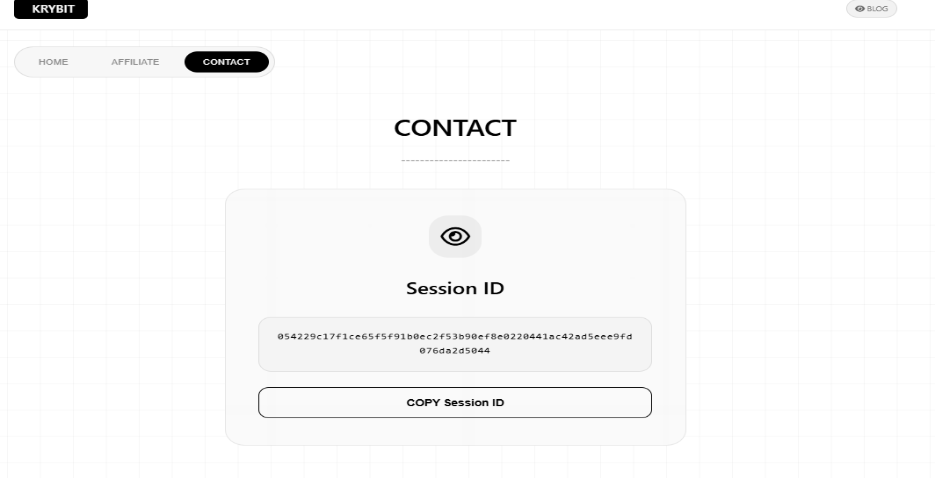
Krybit utilizes a session-based communication model within its affiliate panel, where each victim interaction is assigned a unique Session ID for tracking and management. This enables organized handling of multiple negotiations through a centralized system. While TOX-based encrypted messaging is advertised, the absence of visible identifiers suggests that communication is initially managed internally, reflecting a hybrid approach combining panel-based coordination with external secure channels.
Encryption
- Krybit deploys ransomware payloads across Windows, Linux, VMware ESXi, and NAS environments, demonstrating cross-platform targeting capability across both endpoint and infrastructure systems. Encryption is executed after data exfiltration, ensuring sustained leverage through operational disruption and the threat of data exposure.
- While encryption capability is evident, implementation details — including algorithms, execution flow, and propagation mechanisms — remain undocumented. Advertised flexibility in encryption behavior should be treated with caution, as these claims are not independently validated.
Krybit vs 0APT — Analytical Relevance
The interaction between Krybit and 0APT appears to originate from an extortion attempt by 0APT against Krybit, where 0APT leaked portions of Krybit’s internal panel data to pressure the group. This suggests that 0APT was attempting to position itself as a higher-tier actor by targeting another ransomware operation and leveraging exposed infrastructure for coercion and visibility.
In response, Krybit conducted a retaliatory intrusion against 0APT, compromising its infrastructure, accessing internal data, and disrupting its leak operations. This shift from being targeted to actively countering the threat indicates that Krybit is not only capable of conducting ransomware campaigns but can also engage in offensive actions against competing threat actors.
Observed communication logs provide direct insight into this interaction.
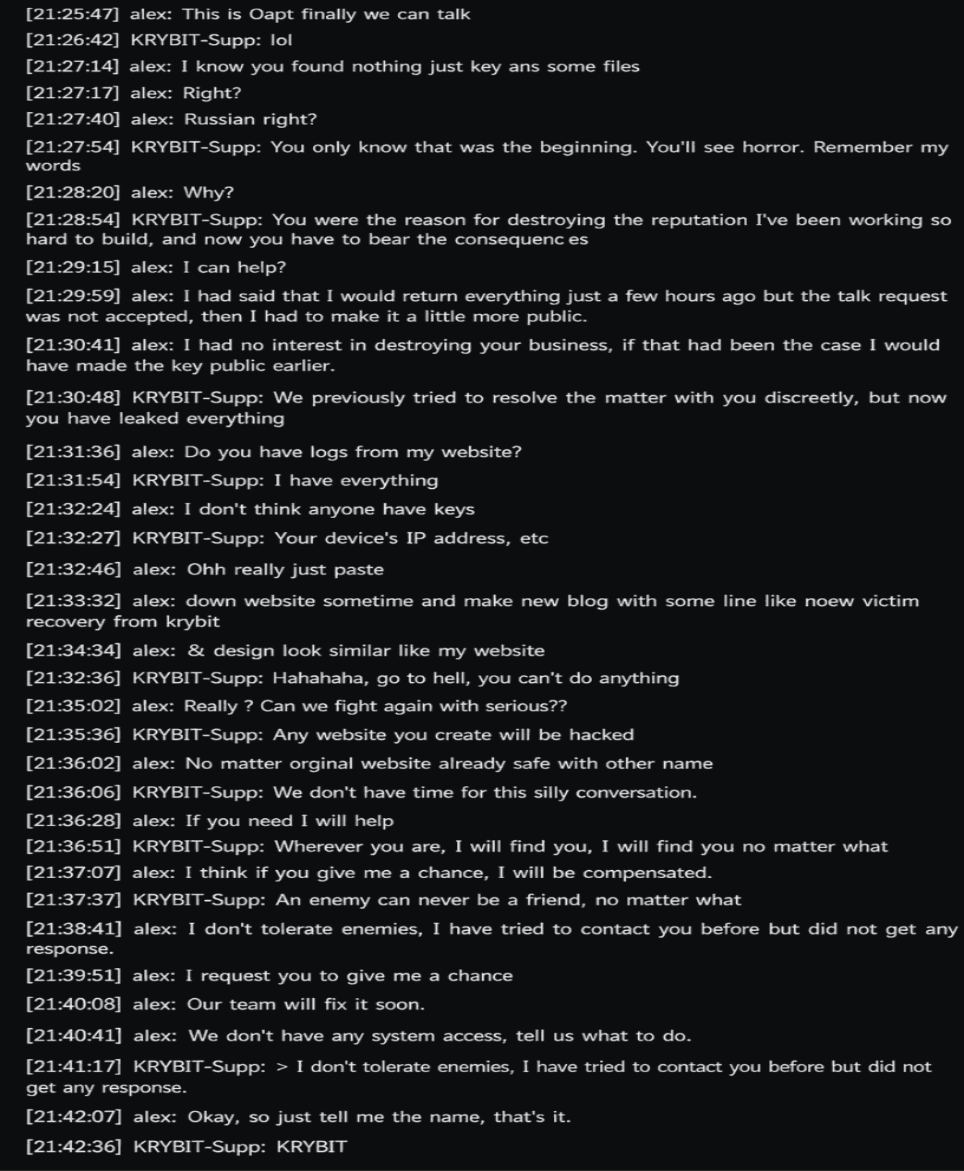
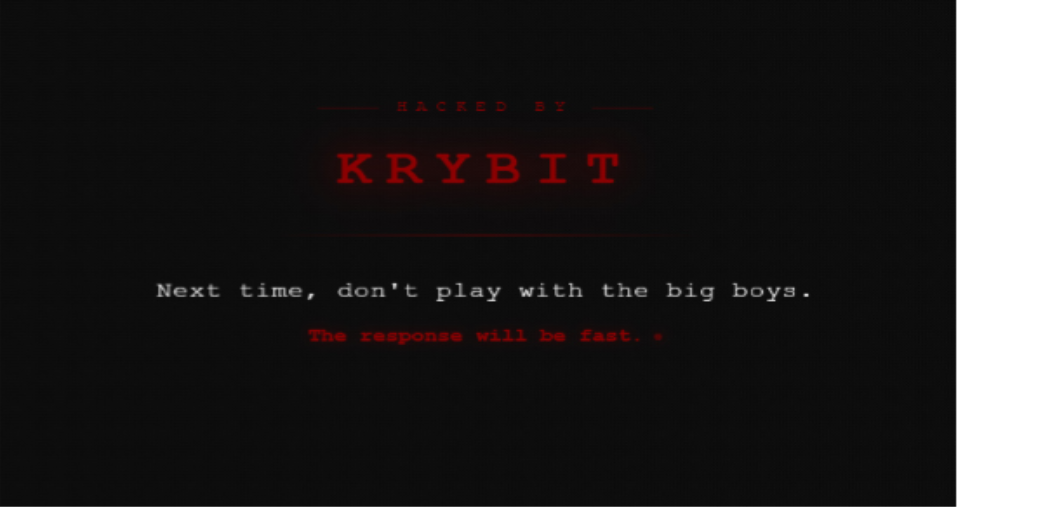
The exchanges show 0APT attempting to negotiate and justify its actions, while Krybit responds with dismissive and aggressive messaging, asserting control and threatening continued impact. Statements indicating possession of sensitive information, including references to logs and system-level data, reinforce Krybit’s claim of successful compromise. The tone and content of the conversation suggest a clear power imbalance, with Krybit maintaining dominance throughout the exchange.
From an intelligence perspective, this interaction reveals several key insights. First, Krybit demonstrates verified intrusion capability beyond standard ransomware operations, including the ability to identify, access, and exploit adversarial infrastructure. Second, the presence of direct communication confirms that the conflict was not superficial but involved active engagement and escalation between both groups. Finally, 0APT’s behavior — including negotiation attempts and inconsistent positioning — indicates weaker operational maturity and credibility, especially when contrasted with Krybit’s response and follow-up actions.
Overall, this incident highlights Krybit as a legitimate and operational ransomware actor with evolving capabilities, while also exposing the limitations of 0APT. The availability of communication evidence significantly strengthens this assessment by providing first-hand visibility into attacker behavior, intent, and capability during a real-world adversarial conflict.
RANSOM NOTE:
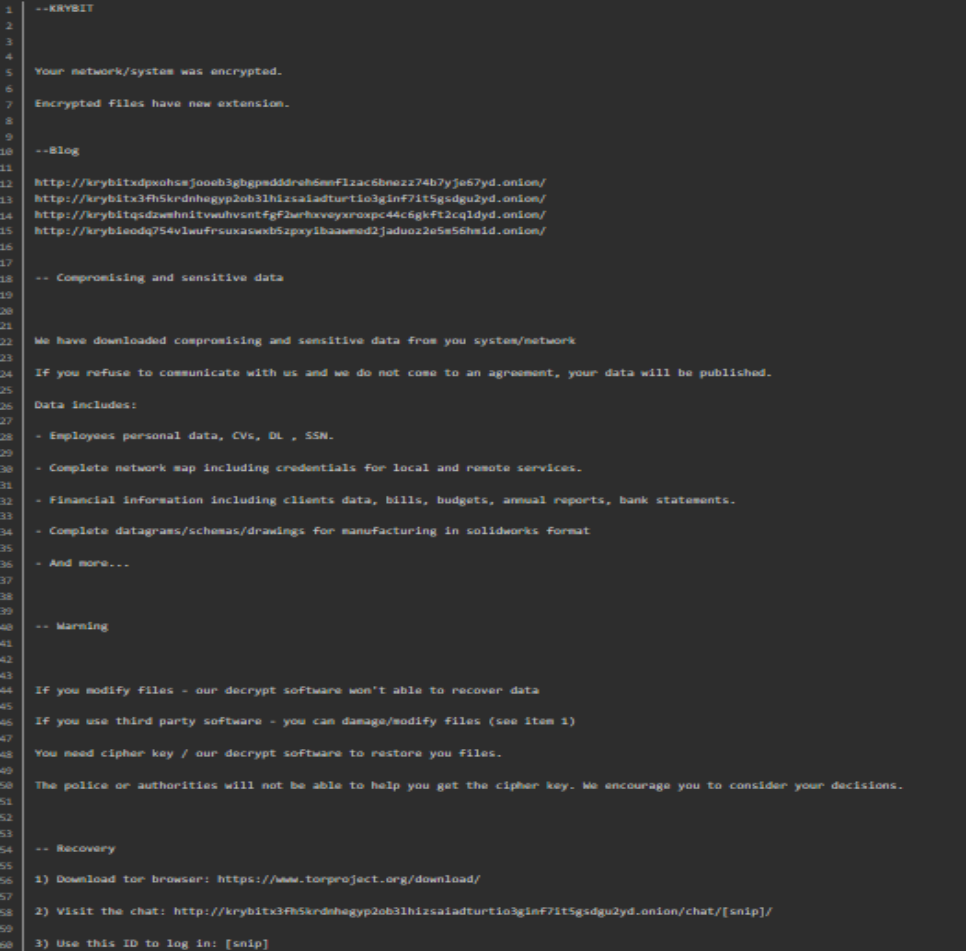
The ransom note follows a typical double extortion model, confirming both data encryption and exfiltration while providing Tor (.onion) links for negotiation and data leak exposure. It applies psychological pressure through warnings against recovery attempts and highlights stolen sensitive data (credentials, financials, employee records) to increase urgency. The structured communication approach and use of unique victim identifiers indicate an organized, repeatable ransomware operation.
MITRE ATT&CK TTPs
|
Tactic |
Technique ID |
Technique Name |
|
Initial Access |
T1566.001 |
Phishing: Spearphishing Attachment |
|
Initial Access |
T1566.002 |
Phishing: Spearphishing Link |
|
Initial Access |
T1078.002 |
Valid Accounts: Domain Accounts |
|
Initial Access |
T1078.003 |
Valid Accounts: Local Accounts |
|
Execution |
T1059.001 |
Command and Scripting Interpreter: PowerShell |
|
Execution |
T1059.003 |
Command and Scripting Interpreter: Windows Command Shell |
|
Stealth |
T1027.013 |
Obfuscated Files or Information: Encrypted/Encoded File |
|
Command and Control |
T1105 |
Ingress Tool Transfer |
|
Command and Control |
T1071.001 |
Application Layer Protocol: Web Protocols |
|
Exfiltration |
T1041 |
Exfiltration Over C2 Channel |
Indicators of Compromise (IOCs)
|
Type |
IOC Value |
|
SHA256 |
dab06e47581b87c21699bb1126b7cb2370cf86d069ad25b9b86cff8e450d7e29 |
|
Data Leak Site |
hxxp://krybitxdpxohsmjooeb3gbgpmdddreh6mnflzac6bnezz74b7yje67yd[.]onion |
|
Data Leak Site |
hxxp://krybitx3fh5krdnhegyp2ob3lhizsaiadturtio3ginf7it5gsdgu2yd[.]onion |
|
Data Leak Site |
hxxp://krybitqsdzwmhnitvwuhvsntfgf2wrhxveyxroxpc44c6gkft2cqldyd[.]onion |
|
Data Leak Site |
hxxp://krybieodq754vlwufrsuxaswxb5zpxyibaawmed2jaduoz2e5m56hmid[.]onion |
Mitigations & Recommendations
1. Initial Access Hardening
- Enforce multi-factor authentication (MFA) across all external access points
- Restrict exposure of internet-facing services such as VPN and remote access interfaces
- Monitor for credential leaks and unauthorized reuse, supported by continuous external monitoring solutions such as CyberXtron DarkFlash
2. Identity & Credential Protection
- Implement least privilege access across all systems and users
- Continuously monitor authentication activity for anomalies using AI-driven analytics platforms such as CyberXtron Xtron AI
- Enforce strong password policies and regular credential rotation
3. Network Security & Lateral Movement Control
- Segment internal networks to isolate critical assets
- Monitor internal traffic for unusual access patterns
- Strengthen visibility into attacker behavior and lateral movement using CyberXtron MCP (Managed Cyber Platform) for real-time investigation and response
4. Endpoint Protection & Monitoring
- Deploy EDR/XDR solutions with behavioral detection capabilities
- Monitor execution activity for signs of obfuscation or abnormal scripting behavior
- Enhance detection and correlation of endpoint threats through platforms such as CyberXtron ThreatBolt
5. Data Protection
- Monitor outbound data transfers for unusual volume or destination
- Implement Data Loss Prevention (DLP) controls
- Identify and prevent external exposure of sensitive data using CyberXtron DarkFlash
6. Backup & Recovery Strategy
- Maintain offline and immutable backups
- Regularly test backup restoration processes
- Ensure separation between production and backup environments
7. Incident Response & Readiness
- Develop and maintain a ransomware-specific incident response plan
- Conduct proactive threat hunting across identity, endpoint, and network layers
Conclusion
Krybit demonstrates a developing ransomware capability supported by a structured affiliate ecosystem, indicating a transition from opportunistic activity toward a more organized operational model. While its current scale remains limited, the combination of identity-driven access methods and a consistent double extortion approach highlights a practical and repeatable attack framework rather than isolated incidents.
At the same time, gaps in technical visibility, partial attribution, and reliance on self-advertised capabilities suggest that the group has not yet reached the maturity of more established ransomware operators. This duality — operational capability alongside observable limitations — positions Krybit as a growing but not fully mature threat, where continued monitoring is essential to track its evolution in tooling, scale, and operational discipline.