


Inside Vercel’s April 2026 Security Incident: Third‑Party OAuth, Elevated Access, and Customer Risk
Executive Summary
A threat actor identified as ShinyHunters claimed responsibility for a security incident involving Vercel and advertised alleged data for sale on an underground forum. Vercel subsequently disclosed unauthorized access to portions of its internal infrastructure, attributing the incident to the compromise of a third-party AI tool (Context[.]ai). The attacker leveraged this access to take control of an employee’s Google Workspace account and gain entry into internal environments, where environment variables not classified as sensitive were accessible, while sensitive variables remained protected. Vercel confirmed that the impact is limited to a subset of customers and that the investigation into the full scope of exposure and potential data exfiltration is ongoing. While the threat actor claims broader access to internal systems, employee accounts, and API credentials, these claims remain unverified and may not reflect the confirmed scope of the incident. Overall, the incident highlights risks associated with third-party integrations, identity-based access, and improper classification of configuration data within modern cloud and SaaS environments.
Key Insight
- Third-party OAuth compromise (Context[.]ai) enabled unauthorized access
- Compromised Google Workspace account used to access internal environments
- Non-sensitive environment variables were exposed; sensitive variables remained protected
- Impact limited to a subset of customers; investigation remains ongoing
- ShinyHunters claimed broader access and data sale; claims remain unverifie
Incident Overview
Vercel identified a security incident involving unauthorized access to portions of its internal infrastructure. The organization has initiated an active investigation, engaging external incident response specialists and coordinating with law enforcement to assess the scope, origin, and impact of the compromise.
Initial findings indicate that the incident originated through a third-party dependency, introducing a supply chain dimension to the attack. The compromise enabled unauthorized access to internal systems via identity-level control rather than direct exploitation of Vercel’s core platform.
The breach has been attributed to the following factors:
- Compromise of a third-party AI tool (Context[.]ai) used by a Vercel employee
- Abuse of Google Workspace OAuth permissions to gain account-level access
- Unauthorized entry into internal Vercel environments
Following initial access, the attacker demonstrated the ability to:
- Take control of an employee’s Google Workspace account
- Access internal systems and associated environments
- Enumerate environment variables that were not classified as sensitive
At the time of disclosure, Vercel has stated :
- Core platform services remain operational with no disruption reported
- The investigation into the incident remains ongoing
- The full scope of data exposure and potential exfiltration has not yet been confirmed
Threat Actor Behind The Incident
ShinyHunters is widely known for involvement in large-scale data breaches and the sale of stolen datasets through underground forums, typically operating with a data extortion and monetization focus.
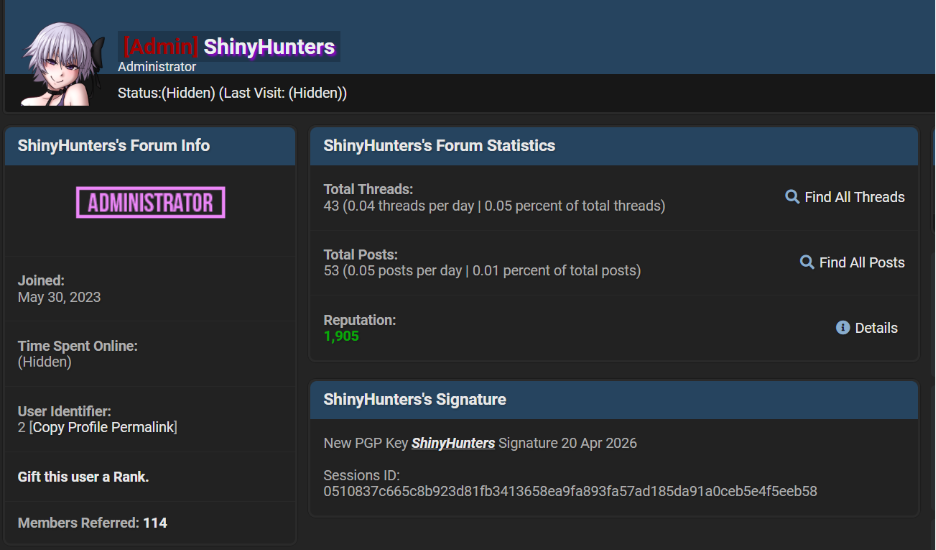
Detailed information about Threat Actor : https://portal.cyberxtron.com/threat-library
Timeline of Events
|
Date & Time |
Event |
|
April 19, 2026 (Early) |
|
|
April 19, 2026 |
|
|
April 19, 2026 (Later) |
|
|
April 20, 2026 |
|
Technical Analysis
Initial Access Vector
The intrusion originated from a third-party compromise involving Context[.]ai, introducing a supply chain element to the incident.
Available findings indicate that the attacker:
- Gained unauthorized access through a compromised Context[.]ai OAuth application
- Leveraged OAuth permissions to compromise a Vercel employee’s Google Workspace account
- Used the compromised account to access Vercel internal environments
This access pathway was enabled through identity compromise rather than direct exploitation of Vercel infrastructure.
Internal Access
Following the compromise of the employee account, the attacker was able to access Vercel internal environments.
Confirmed activities include:
- Access to internal systems associated with the compromised account
- Interaction with environment configurations
- Enumeration of environment variables accessible within that context
There is currently no publicly confirmed evidence indicating access beyond the scope of the compromised account.
Environment Variable Exposure
The primary exposure vector in this incident involves environment variables.
- Environment variables classified as non-sensitive were accessible
- Environment variables marked as sensitive remained protected and were not readable
However, Vercel has advised that:
- Non-sensitive variables may contain operational or credential-related data
- Such values should be treated as potentially exposed and rotated
This indicates a potential risk associated with how environment variables were classified and managed.
Investigation Status
Based on current disclosures:
- The investigation into the incident remains ongoing
- The full scope of data exposure has not yet been confirmed
- Vercel has stated it will notify affected customers if further evidence of compromise is identified
Underground Leak Alert
A threat actor identified as ShinyHunters published a listing on a cybercrime forum, claiming to have breached Vercel and offering alleged data for sale.
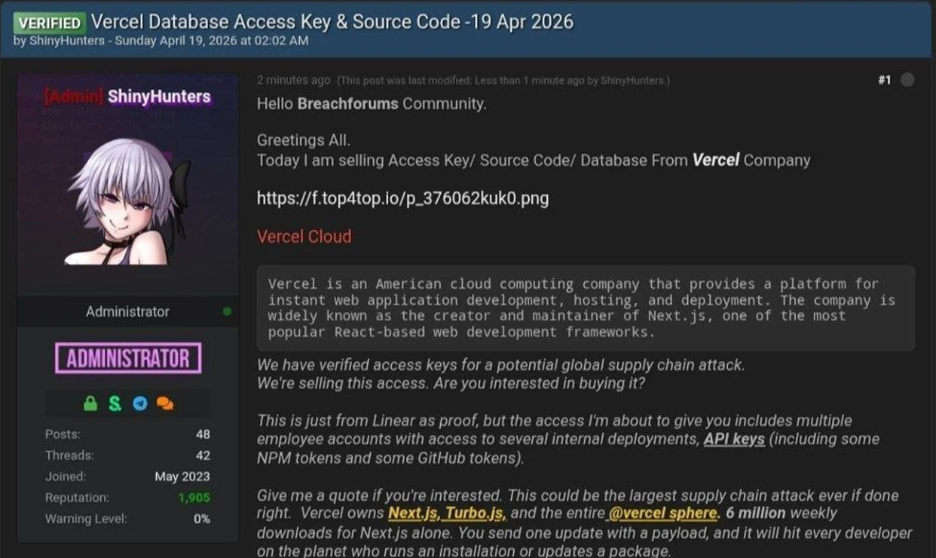
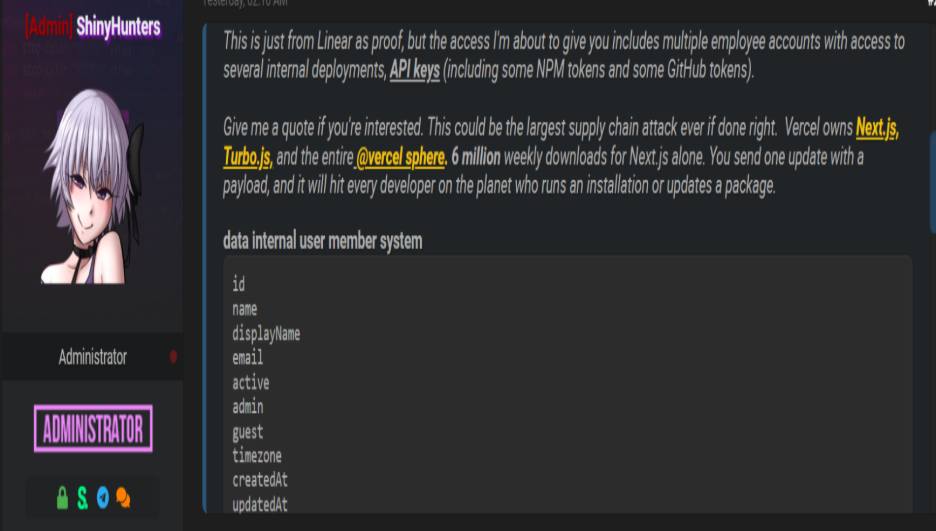
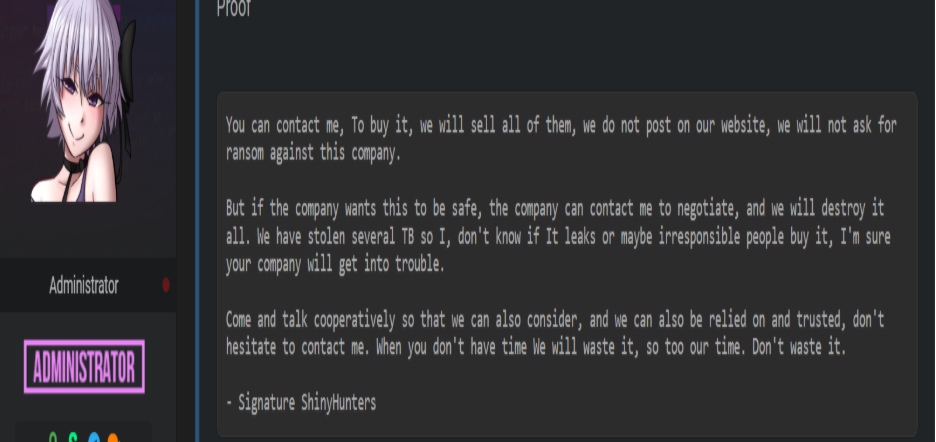
The listing explicitly states that the access could enable a potential supply chain attack, referencing Vercel’s ecosystem, including frameworks such as Next.js and Turbo.js.
Impact Assessment
The impact of the Vercel security incident, based on current disclosures and observed threat actor claims, is centered around unauthorized access to internal environments and exposure of certain environment variables. Vercel has confirmed that the incident affected a limited subset of customers and involved environment variables that were not classified as sensitive, while sensitive variables remained protected. Affected users were notified and advised to rotate credentials.
Additionally, the threat actor’s forum post, as evidenced in the provided screenshots, claims broader access to internal systems and data. These claims include access to employee accounts, internal deployment environments, and API credentials, along with references to internal user directory data. The actor also advertises the sale of this access and associated data for $2 million and positions the access as potentially enabling a supply chain attack within the Vercel ecosystem. These claims remain unverified and may not reflect the confirmed scope of the incident.
Based on the forum listing, the threat actor claims access to and is offering for sale:
- Access keys
- Source code
- Database data
- Employee accounts
- Internal deployment environments
- API credentials, including GitHub and NPM tokens
Additional elements observed within the forum post include:
- A sample internal user directory dump, containing employee-related records such as email addresses, account status, and activity metadata
- A stated price of $2 million USD for the alleged dataset and access
- A statement indicating willingness to negotiate directly with the affected organization and delete the data upon agreement .
**KEY NOTES:
-
These claims are based solely on the threat actor’s forum post and supporting attached images
-
The authenticity and completeness of the data, as well as the actual extent of compromise, have not been independently verified
-
The claims may not accurately reflect the confirmed scope of the Vercel incident
MITRE ATT&CK TTPs (Based on Observations)
|
Tactic |
Technique ID |
Technique Name |
|
Initial Access |
T1195.002 |
Supply Chain Compromise: Compromise Software Supply Chain |
|
Initial Access |
T1078.004 |
Valid Accounts: Cloud Accounts |
|
Credential Access |
T1528 |
Steal Application Access Token |
|
Credential Access |
T1552.001 |
Unsecured Credentials: Credentials In Files |
|
Persistence |
T1078.004 |
Valid Accounts: Cloud Accounts |
|
Discovery |
T1526 |
Cloud Service Discovery |
|
Discovery |
T1083 |
File and Directory Discovery |
|
Collection |
T1530 |
Data from Cloud Storage |
|
Exfiltration |
T1567 |
Exfiltration Over Web Service |
|
Impact |
T1657 |
Financial Extortion |
Indicators of Compromise (IOCs)
Official IOC (Vercel Disclosure)
The following indicator has been officially disclosed by Vercel as part of the incident investigation:
Malicious OAuth Application:
110671459871-30f1spbu0hptbs60cb4vsmv79i7bbvqj[.]apps[.]googleusercontent[.]com
**Organizations should review Google Workspace environments for the presence of this application and revoke access if identified.
Indicators of Compromise : ShinyHunters
|
DOMAIN |
|
corporate-microsoft[.]com |
|
sharepoint-comcast[.]com |
|
sharepoint-workplaceview[.]com |
|
corporate-okta[.]com |
|
recurly-zoom[.]com |
|
modernatx-zoom[.]com |
|
get-carrot-zoom[.]com |
|
bless-invite[.]com |
|
allvuesystems-okta[.]com |
|
help-allvuesystems[.]com |
|
workday-hubspot[.]com |
|
signin-okta[.]com |
|
admiring-shockley[.]196-251-83-162[.]plesk[.]page |
|
bmcorpuser[.]internal-okta[.]com |
|
dashboard-salesforce[.]com |
|
my-ticket-portal[.]com |
|
login-salesforce[.]com |
|
IP |
|
163[.]5[.]169[.]142 |
|
198[.]244[.]224[.]200 |
|
94[.]156[.]167[.]237 |
|
163[.]5[.]210[.]210 |
|
191[.]96[.]207[.]179 |
|
HASH |
|
4e20f2c4c90e3654a8c43fb10003978d61d2b48426414dede3b1bd5a2c891b54 |
|
e5c5617c8676e9a5cf6108d344fe7fcb6590671efd6baccb02b9313da0f0d289 |
|
0383c0d109b7cfdef058b0197125c85d276510724be33a746056f9a7c181d761 |
|
6aa51de51a6b352fd073b5b9080011d358d42fa190a8a9ee216e3ef6e657b801 |
|
36de93aaf26727f6dd55ff2100b08dfb52abccfb57a7bf4d07a7fb703a86623d |
Mitigations & Recommendations
1. Third-Party & OAuth Access Control
• Restrict and audit third-party application integrations (e.g., OAuth apps) across enterprise environments
• Enforce approval workflows for granting OAuth permissions, especially “Allow All” scopes
• Continuously monitor and review connected applications within Google Workspace and other identity providers
• Revoke unused or unauthorized third-party integrations immediately
• Validate security posture of third-party tools before enterprise adoption
2. Identity & Account Security
• Enforce multi-factor authentication (MFA) across all enterprise accounts, including Google Workspace
• Monitor for anomalous login activity and unauthorized account access
• Implement conditional access policies based on device, location, and risk signals
• Restrict privilege escalation paths from standard user accounts
• Regularly audit account permissions and access scopes
3. Environment Variable & Secret Management
• Classify all sensitive data correctly and enforce use of “sensitive” environment variable controls
• Avoid storing API keys, tokens, or credentials in non-sensitive configurations
• Rotate all environment variables, especially those previously not marked as sensitive
• Implement centralized secret management solutions where feasible
• Audit environment configurations for exposed or misclassified secrets
4. CI/CD & Deployment Security
• Review and secure deployment pipelines and environment configurations
• Restrict access to deployment systems and enforce least-privilege access
• Monitor deployment activity for unauthorized or unexpected changes
• Rotate deployment tokens and access credentials regularly
• Enable deployment protection mechanisms across all environments
5. API Key & Integration Security
• Rotate API keys and tokens associated with affected environments (e.g., GitHub, NPM)
• Limit API key permissions to required scopes only
• Monitor API usage for abnormal patterns or unauthorized access
• Revoke and reissue exposed or potentially compromised credentials
• Maintain visibility into third-party service integrations
6. Monitoring & Detection
• Monitor account activity logs for suspicious actions across environments
• Track access to environment variables and configuration changes
• Detect unauthorized use of OAuth applications and token abuse
• Implement alerting for abnormal access to internal systems
• Continuously review logs for indicators of compromise (IOCs)
7. Incident Response & Recovery
• Immediately investigate any indicators of unauthorized access
• Revoke compromised sessions and reset affected accounts
• Conduct environment-wide credential rotation where exposure is suspected
• Validate integrity of deployments and configurations
• Maintain coordination with platform providers for ongoing updates and guidance
Conclusion
A threat actor identified as ShinyHunters claimed responsibility for the Vercel security incident and advertised alleged data for sale on an underground forum. Vercel disclosed unauthorized access to portions of its internal infrastructure, originating from the compromise of a third-party AI tool (Context[.]ai), which enabled an attacker to take control of an employee’s Google Workspace account and access internal environments, including environment variables not classified as sensitive, while sensitive variables remained protected. Vercel confirmed that the impact is limited to a subset of customers, and the investigation into the full scope of exposure and potential data exfiltration remains ongoing. Threat actor claims also include broader access to employee accounts, internal deployment environments, and API credentials; however, these claims remain unverified and may not reflect the confirmed scope of the incident. Overall, the incident underscores the security risks associated with third-party integrations, identity-based access, and improper classification of configuration data within modern cloud and SaaS environments.