


CMD Organization: Threat Profile of an Emerging Auction-Based Ransomware Operation
EXECUTIVE SUMMARY
CMD Organization is an emerging ransomware operation observed since March 2026, leveraging a hybrid extortion model that combines data exfiltration, encryption, and a unique auction-based monetization strategy. Unlike traditional ransomware groups, CMD integrates public bidding mechanisms that allow third parties to purchase stolen data, reducing reliance on direct victim negotiations. The group operates a segmented infrastructure across TOR and clearnet environments, enabling both anonymity and accessibility, while targeting data-rich organizations across multiple sectors and regions. Although technically limited and reliant on commodity tooling, CMD demonstrates evolving operational capability through its platform-driven approach, positioning stolen data as a tradable asset and indicating a shift toward marketplace-based cybercrime models.
KEY INSIGHTS:
- CMD Organization introduces an auction-based model, enabling third-party bidding on stolen data
- Dual TOR and HTTPS infrastructure increases both anonymity and accessibility
- Segmented architecture separates storage, exposure, and monetization workflows
- Focus is on data value and resale rather than advanced malware capability
- Represents a shift toward marketplace-driven ransomware operations
Threat Profile
Group Overview
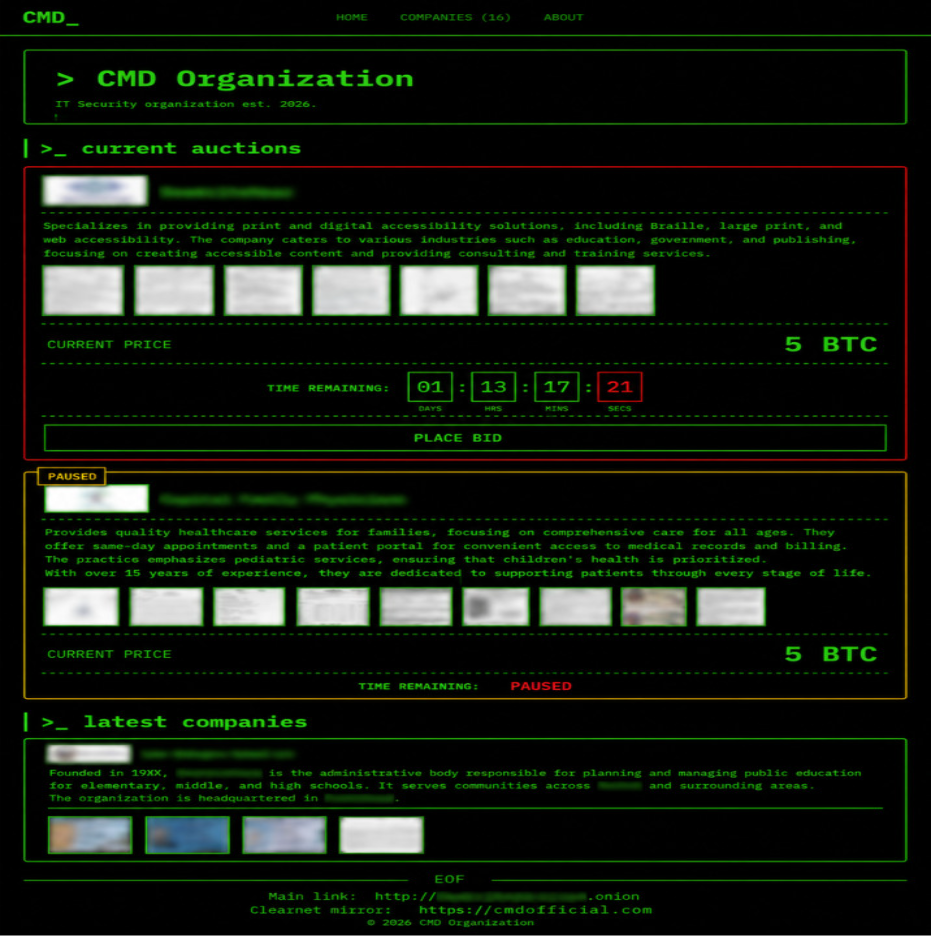
CMD Organization is a ransomware operator leveraging a hybrid extortion model that includes:
- Data exfiltration and encryption (double extortion)
- Public data auctions
- Direct extortion
- Free leaks and re-leak strategies
The group maintains both TOR and clearnet infrastructure, increasing accessibility while preserving anonymity. Its operations are structured to support not only victim coercion but also third-party engagement through auction-based data sales.
CMD presents itself as a security-focused entity, claiming to identify vulnerabilities in corporate environments. This positioning aligns with common ransomware narratives used to legitimize malicious activity.
Operational Characteristics
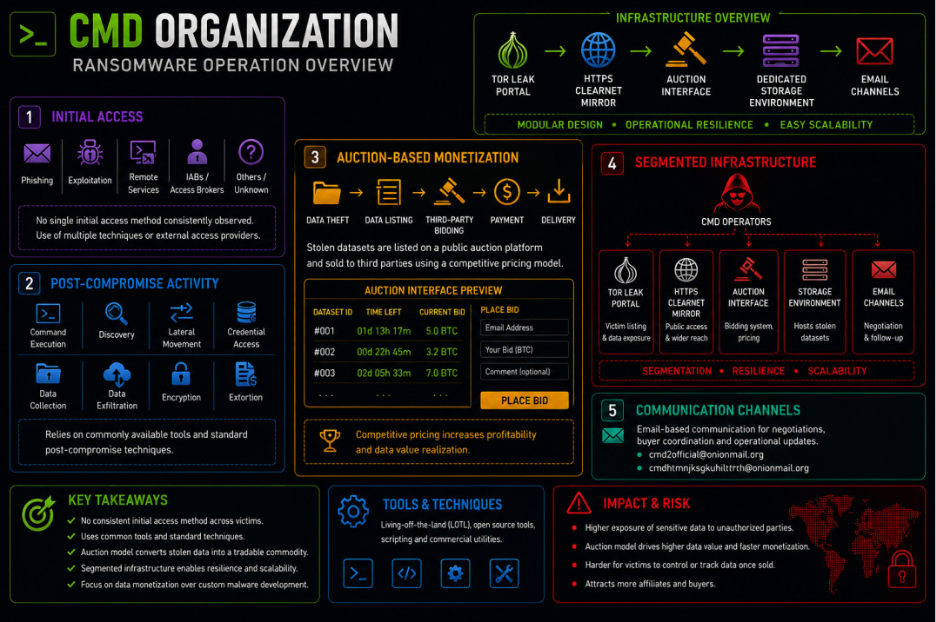
CMD Organization follows a general ransomware lifecycle but diverges significantly in how it monetizes stolen data.
Victimology
Overview
|
Metric |
Value |
|
Total Victims |
19+ |
|
Countries Affected |
6 |
|
Active Since |
March 2026 |
|
Leak Site |
Active |
CMD Organization demonstrates a limited but geographically distributed victim base, consistent with an early-stage ransomware operation. The absence of a dominant geographic concentration suggests an opportunistic targeting model, with victims spread across multiple regions rather than focused campaigns. This pattern indicates that initial access is likely driven by availability and ease of compromise rather than strategic regional selection.
Sector distribution shows a tendency toward data-rich environments, particularly organizations handling sensitive personal, financial, or operational data. Combined with its auction-based monetization model, this reflects a focus on maximizing data value rather than victim volume. Despite its small scale, CMD’s cross-sector and multi-country presence highlights an expanding operational footprint, with scalability driven by its marketplace-style extortion approach rather than traditional negotiation-dependent ransomware tactics.
Geographical Distribution
CMD Organization exhibits a partially concentrated victim footprint, with a clear dominance in the United States and limited activity across other regions. Unlike globally distributed ransomware groups, the observed data reflects a skewed distribution rather than balanced geographic spread. The majority of victims are located in a single country, while the remaining cases are sparsely distributed, indicating relatively clear geographic visibility with minimal ambiguity in attribution.
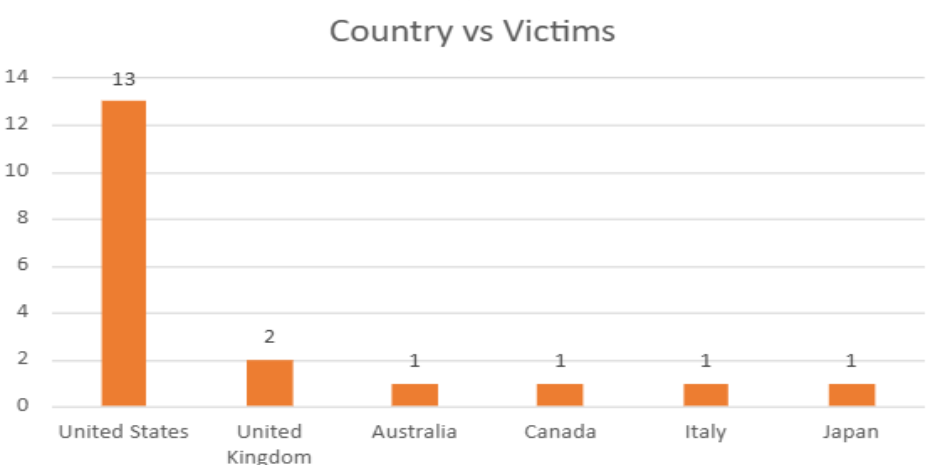
Among identified countries, the United States (13 victims) represents the overwhelming majority of cases, followed by the United Kingdom (2 victims). Other countries — including Australia, Canada, Italy, and Japan (1 victim each) — reflect low-frequency and isolated targeting. This pattern does not indicate broad regional expansion but instead highlights a concentrated footprint with limited international reach.
Regionally, North America shows the highest concentration due to the dominance of the United States, while Europe and Asia-Pacific demonstrate minimal and fragmented activity. The absence of sustained multi-country clustering suggests that CMD Organization is not executing regionally focused campaigns. Instead, the distribution reflects a narrow but expanding operational presence, where activity outside the primary region remains sporadic and low in volume, consistent with an early-stage ransomware operation..
Sector Targeting
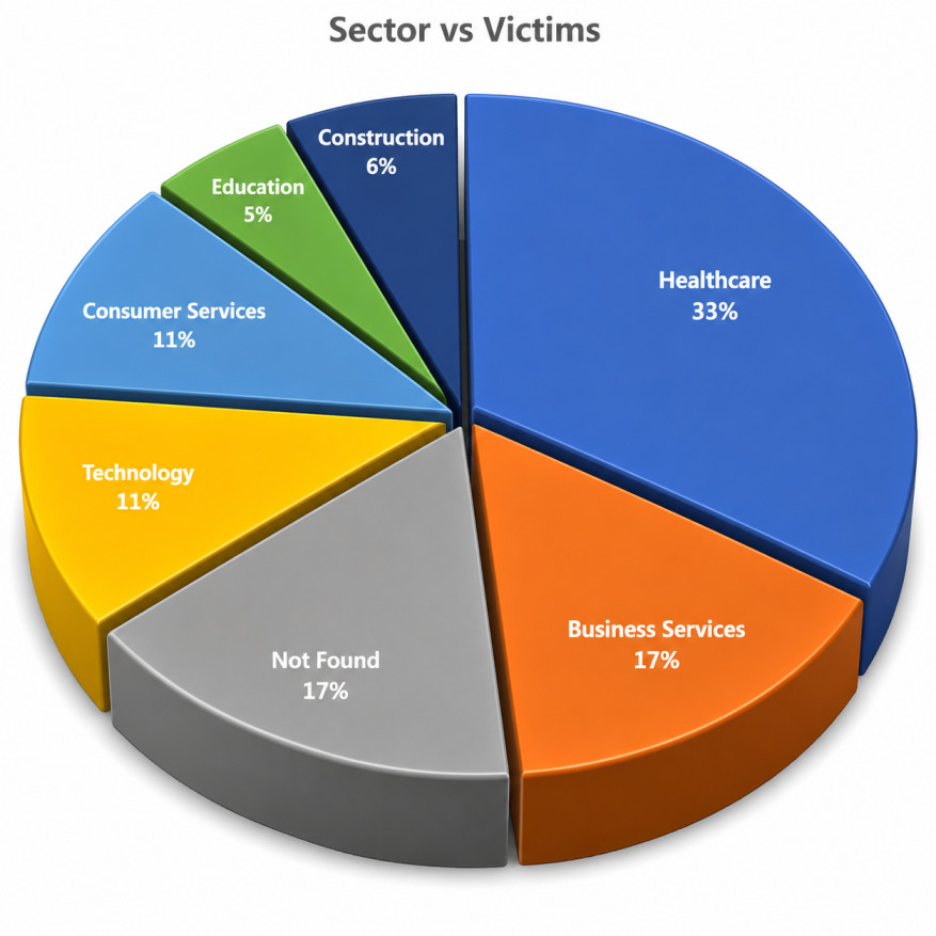
CMD Organization’s sector distribution reflects a partially concentrated targeting pattern with a strong emphasis on data-rich industries. Healthcare (33%) represents the largest share, indicating a clear prioritization of environments handling sensitive medical and identity data. This is followed by Business Services (17%) and Not Found / Other (17%), suggesting a combination of structured targeting and some attribution gaps or less-profiled victims.
Technology (11%) and Consumer Services (11%) show consistent activity, highlighting exposure across digitally dependent and customer-facing sectors. Construction (6%) and Education (5%) represent lower-frequency targeting, indicating expansion into operational and institutional environments without sustained focus.
This distribution indicates a skewed rather than balanced spread across sectors, with a clear concentration in high-value data environments. The pattern aligns with a data-driven targeting approach, where sector selection is influenced by the sensitivity and potential resale value of compromised data rather than evenly distributed or highly specialized industry targeting.
Technical Analysis
Initial Access and Foothold:
Available intelligence does not establish a consistent initial access vector across CMD Organization incidents. The absence of repeatable patterns suggests variability in intrusion methods or potential reliance on externally obtained access, such as compromised credentials or exposed services.
There is no confirmed evidence of vulnerability exploitation or advanced intrusion techniques. Observed behavior indicates dependence on commonly available tools and access pathways, with further clarity expected as additional incidents are analyzed.
Privilege Escalation, Defense Evasion, and Persistence:
CMD Organization demonstrates reliance on standard post-compromise techniques rather than custom-developed tooling. Execution is likely performed through commonly available utilities, enabling controlled activity within compromised environments without introducing identifiable malware signatures.
Techniques related to privilege escalation, persistence, and defense evasion remain unconfirmed, with no consistent tooling or repeatable mechanisms documented. These stages lack sufficient visibility and remain under observation.
Lateral Movement, Exfiltration, and Encryption:
Lateral Movement
Lateral movement techniques are not clearly defined, with no confirmed tooling or standardized propagation methods observed. Internal movement is likely achieved through credential reuse and standard administrative protocols, though this remains unverified.
Attack Sequence
- Initial access through exposed or externally obtained access
- Execution using command and standard system utilities
- Internal reconnaissance and data identification
- Data exfiltration to attacker-controlled infrastructure
- Deployment of ransomware payload
- Execution of double extortion and auction-based monetization
Data exfiltration is a confirmed pre-encryption activity, supporting CMD Organization’s dual monetization model of extortion and third-party data sales.
Command and Control (C2):
Available intelligence indicates the use of attacker-controlled infrastructure for operational coordination and data handling, implying the presence of command-and-control (C2) communication.
Detailed characteristics — including protocol usage, beaconing behavior, and infrastructure design — remain unconfirmed, with no evidence of advanced or uniquely identifiable C2 frameworks at this stage.
Communication and Platform Analysis:
CMD Organization utilizes a hybrid communication model combining web-based interaction and direct contact channels. The presence of email-based communication suggests manual handling of victim and bidder interactions, particularly within its auction workflow.
Unlike traditional ransomware groups relying solely on negotiation portals, CMD integrates a bidding interface where third parties can participate in data acquisition. This indicates a partially manual backend process, where transactions and coordination may not be fully automated.
Encryption:
CMD Organization deploys a ransomware payload to encrypt victim systems following data exfiltration. Encryption serves as a secondary pressure mechanism alongside data exposure and resale.
Implementation details — including encryption algorithms, execution flow, and propagation mechanisms — remain undocumented. There is no evidence of advanced capabilities such as automated spreading, selective encryption logic, or modular payload architecture, suggesting reliance on basic or externally sourced tooling
Leak Site and Infrastructure Analysis:
CMD Organization operates a segmented infrastructure model consisting of a TOR-based leak portal, a clearnet (HTTPS) mirror, an auction interface, and a dedicated storage environment for hosting stolen data. This multi-layered design enables separation between data hosting, public exposure, and monetization workflows, providing both operational resilience and flexibility.
The use of dual access points (TOR and HTTPS) increases accessibility for victims and potential buyers while maintaining anonymity for core operations. This approach reduces dependency on TOR-only access and lowers barriers for third-party participation in the extortion process.
From an architectural perspective, CMD demonstrates a multi-component platform model rather than a traditional ransomware leak site. The ecosystem includes:
- Leak / Auction Platform – Public victim listings, data previews, bidding interface, and time-based exposure mechanisms
- Storage Portal (TOR) – Dedicated environment for hosting and distributing stolen datasets, isolated from the public interface
- Clearnet (HTTPS) Mirror – Improves accessibility and visibility, particularly for non-technical users
- Email Communication Layer – Supports negotiation and bidder interaction, indicating partially manual backend operations
This separation introduces operational redundancy and risk isolation between components, while enabling scalability in monetization workflows.
The auction-based system represents a key deviation from traditional ransomware models. Stolen datasets are listed, previewed, and offered to third parties, introducing a competitive pricing mechanism and shifting reliance away from direct victim negotiation.
Key observations include:
- Public bidding interface integrated into the leak platform
- Absence of visible automated cryptocurrency escrow mechanisms
- Manual bidder coordination via email channels
- Dataset previews provided prior to purchase
These characteristics suggest that the platform is functional but not fully mature, with backend processes likely handled manually. Overall, CMD’s infrastructure reflects an evolving model where stolen data is treated as a tradable asset within a controlled marketplace, marking a transition from negotiation-driven ransomware toward platform-based cybercrime operations.
MITRE ATT&CK TTPs
|
Tactic |
Technique ID |
Technique Name |
|
Initial Access |
T1566.002 |
Phishing: Spearphishing Link |
|
Initial Access |
T1078.002 |
Valid Accounts: Domain Accounts |
|
Initial Access |
T1078.003 |
Valid Accounts: Local Accounts |
|
Execution |
T1059.001 |
Command and Scripting Interpreter: PowerShell |
|
Execution |
T1059.003 |
Command and Scripting Interpreter: Windows Command Shell |
|
Stealth |
T1027.013 |
Obfuscated Files or Information: Encrypted/Encoded File |
|
Discovery |
T1046 |
Network Service Discovery |
|
Lateral Movement |
T1021.002 |
Remote Services: SMB/Windows Admin Shares |
|
Command and Control |
T1071.001 |
Application Layer Protocol: Web Protocols |
|
Command and Control |
T1105 |
Ingress Tool Transfer |
|
Collection |
T1005 |
Data from Local System |
|
Exfiltration |
T1041 |
Exfiltration Over C2 Channel |
|
Impact |
T1486 |
Data Encrypted for Impact |
Indicators of Compromise (IOCs)
|
Type |
IOC Value |
|
Data Leak Site |
hxxp://cmdnkiqjije2tllr3biee2sjgj3i4robg2cbtilbnytdhh2wy3syrlyd[.]onion |
|
Domain |
Www[.]cmdofficial[.]com |
|
Domain |
cmdofficial[.]com |
|
Domain |
Mail[.]cmdofficial[.]com |
|
Domain |
Autodiscover[.]cmdofficial[.]com |
|
Domain |
Cpcontacts[.]cmdofficial[.]com |
Mitigations & Recommendations
1. Initial Access Hardening
- Enforce multi-factor authentication (MFA) across all external access points
- Restrict exposure of internet-facing services such as VPN, RDP, and remote access interfaces
- Monitor for credential leaks, exposed assets, and unauthorized account exposure using CyberXtron DarkFlash
2. Identity & Credential Protection
- Implement least privilege access across all systems and users
- Continuously monitor authentication activity for anomalies using XTron AI
- Enforce strong password policies and periodic credential rotation
3. Network Security & Lateral Movement Control
- Segment internal networks to isolate critical systems and sensitive data
- Monitor internal traffic for unusual access patterns and unauthorized lateral movement
- Improve investigation and visibility across network activity using CyberXtron MCP (Managed Cyber Platform)
4. Endpoint Protection & Threat Monitoring
- Deploy EDR/XDR solutions with behavioral detection capabilities
- Monitor PowerShell, command-line execution, and suspicious scripting activity
- Enhance threat detection and security monitoring through CyberXtron ThreatBolt
5. Data Protection & Exposure Management
- Monitor outbound traffic for unusual data transfer activity
- Implement Data Loss Prevention (DLP) controls across sensitive environments
- Identify exposed assets, leaked credentials, and publicly accessible data through CyberXtron DarkFlash
6. Brand & External Risk Monitoring
- Monitor for unauthorized use of organizational data, leaked information, and external threat exposure
- Track potential abuse of corporate identity and public-facing assets using CyberXtron BrandSafe
- Monitor attack-surface visibility and external exposure risks on clear web and underground sources
7. Backup & Recovery Strategy
- Maintain offline and immutable backups of critical systems
- Regularly test restoration procedures to validate recovery readiness
- Ensure logical separation between production and backup environments
8. Incident Response & Readiness
- Develop and maintain a ransomware-specific incident response plan
- Conduct proactive threat hunting across identity, endpoint, network, and cloud environments
- Accelerate investigation, triage, and response workflows using CyberXtron MCP and AI-assisted analysis through XTron AI
CONCLUSION
CMD Organization represents an emerging ransomware operation that prioritizes monetization strategy over technical sophistication. While its current scale and tooling indicate a relatively early-stage actor, the group demonstrates a clear shift in operational design through its auction-based model, enabling third-party participation in data acquisition. This approach reduces dependence on traditional ransom negotiations and introduces a competitive pricing dynamic, increasing pressure on victims while expanding revenue opportunities.
At the same time, CMD’s segmented infrastructure and dual-access model (TOR and HTTPS) highlight an evolving platform-driven architecture focused on scalability and accessibility. Despite the absence of advanced techniques or consistent attack patterns, the group’s emphasis on data commoditization signals a broader transition in ransomware operations toward marketplace-based cybercrime ecosystems. Continued monitoring is essential, as CMD’s model—if matured—has the potential to influence future ransomware strategies beyond conventional extortion frameworks.