


Accenture Data Breach 2026: Source Code, RSA/SSH Keys, and Azure Credentials Exposed
Executive summary
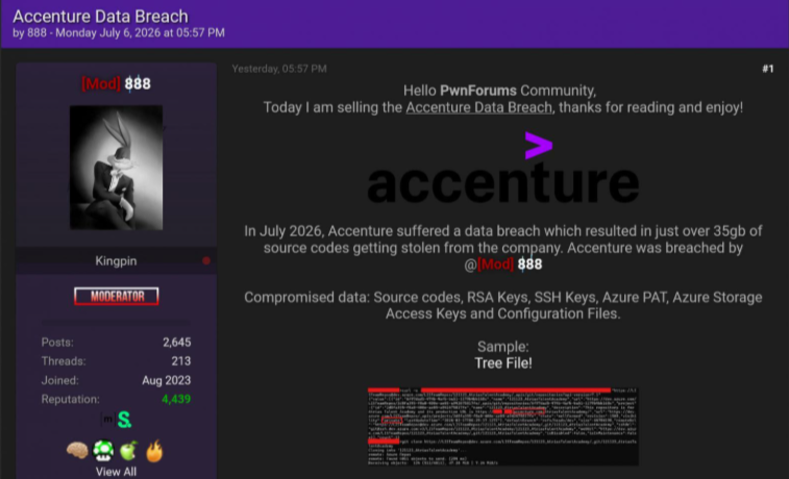
On July 8, 2026, Accenture confirmed it had suffered a security breach after a threat actor “888” claimed to have stolen 35 GB of source code ,RSA and SSH keys, Azure credentials, and configuration files containing potentially sensitive environment details. Subsequently, it confirmed an isolated breach and said it had remediated the source.
Key takeaways
- The incident appears to center on developer-infrastructure compromise, especially Azure DevOps access.
- If the claimed credentials are real, the impact could include repository access, cloud resource abuse, and supply-chain risk.
- Source code and configuration exposure is especially sensitive because it cannot be “rotated” the way passwords can.
Attacker profile
The actor uses the handle “[Mod]888” joined in Aug 2023 and appears to operate as a forum-based data extortion seller rather than a public ransomware brand. Reporting also suggests this actor may have made earlier unverified claims about Accenture in 2024, which points to a recurring interest in the company.
The forum listing also tagged several other known handles, including 'IntelBroker' (whose account appears struck through, suggesting it may be inactive or banned) and other users such as 'EnergyWeaponUser' and 'wonder.' The '888' account itself carries a moderator tag on the forum, indicating an established presence rather than a throwaway account.
The behavior fits an access-broker or leak-for-sale profile: steal data, show proof, and demand payment in XMR.
Attack method
The attacker allegedly posted a forum listing offering stolen data for sale and included a screenshot showing Azure DevOps command-line activity and a git clone of a private repository.
That proof strongly suggests access to a live developer environment, likely through a compromised Azure Personal Access Token or another valid secret.
The sample output showed a curl request to a dev.azure.com endpoint, followed by a git clone command targeting the repository 121123_AtriasTalentAcademy. The repository was said to be hosted under a production Accenture domain, with metadata and remote URLs consistent with Azure Repos infrastructure.
The screenshot also showed an in-progress git clone pulling thousands of objects at high transfer speeds, which the threat actor used as proof of active access. The presence of Azure PATs, SSH keys, and storage keys in the sample suggests the actor may have used valid credentials, potentially bypassing traditional perimeter defenses.
The actor offered the data for sale exclusively in Monero (XMR), a privacy-focused cryptocurrency commonly used on cybercrime marketplaces, making transaction tracing more difficult for law enforcement. No public price had been listed at the time of reporting.
Targeted country
Accenture is headquartered in Dublin, Ireland, but the exact target country is unknown.
Targeted industry
The victim sits in the IT services, consulting, cloud engineering, and managed services sector.
Victims
The direct victim is Accenture, including its internal Azure DevOps environment.
MITRE TTP
- T1078 Valid Accounts, for use of stolen or valid PATs and keys.
- T1552 Unsecured Credentials, for exposed secrets in code or config files.
- T1219 Remote Access Software, if the access path involved developer tooling or remote admin channels.
- T1021 Remote Services, for access to Azure DevOps and related internal services.
- T1041 Exfiltration Over C2 Channel, for data removal through attacker-controlled infrastructure.
- T1588 Obtain Capabilities, if the attacker acquired access material from prior breaches or dumps.
- T1083 File and Directory Discovery, consistent with repository browsing and cloning.
Mitigation recommendation
- Revoke and rotate all Azure PATs, SSH keys, RSA keys, and storage access keys.
- Review Azure DevOps audit logs, repository access history, and token issuance records.
- Enforce secret scanning and prevent credentials from being committed to repos.
- Reduce PAT lifetime, scope, and use; prefer short-lived, least-privilege authentication.
- Segment DevOps access and require MFA for all privileged accounts.
- Validate whether any pipeline artifacts, build scripts, or deployment configs expose additional secrets.
- Treat all source code as potentially disclosed and perform supply-chain risk review for downstream customers.
Conclusion
The Accenture breach highlights a shift toward targeting developer infrastructure . Azure DevOps repos, access tokens, and cryptographic keys rather than networks or employee data. Unlike passwords, exposed source code and secrets can't simply be rotated, making full containment harder even after remediation.
Accenture has confirmed the breach and remediated the access point, but hasn't verified the attacker's claims about scope or data type. Given Accenture's reach across finance, healthcare, energy, and government clients, the bigger risk is downstream: organizations relying on Accenture-managed code and infrastructure should treat this as a prompt to review credential hygiene, secret scanning, and least-privilege access in their own environments.