


Akira Unmasked: CyberXTron Analysis Reveals VPN Exploitation Tactics Driving Global Double-Extortion Campaigns
Strategic Summary:
Akira is a Ransomware-as-a-Service (RaaS) group that emerged in March 2023, targeting both Windows and Linux (ESXi) environments. Since its inception, the group has claimed responsibility for over 1,113 confirmed victims worldwide, primarily concentrated in the United States and Canada. Akira represents about 9.13% of global ransomware attacks in 2025, making it significant but not dominant. Akira’s operations heavily impact manufacturing, business services, technology, and financial sectors, exploiting VPN vulnerabilities such as CVE-2023-20269, CVE-2022-40684, and CVE-2024-40766 for initial access. The group employs legitimate tools like AnyDesk, Cobalt Strike, and VeeamHax for persistence, credential theft, and encryption. Its continued evolution, global reach, and high operational tempo reinforce Akira’s position as one of the most active and financially motivated ransomware threats of 2025.
Profile:
Initially identified in early 2023, Akira began as a moderately sophisticated operation that used conventional intrusion methods before maturing into a highly coordinated affiliate-based RaaS model. Its affiliates employ a mix of credential compromise, post-exploitation frameworks, and cloud service manipulation to gain persistence and control within victim networks. A hallmark of Akira’s evolution through 2024-2025 is its transition from opportunistic intrusions to strategically targeted campaigns exploiting exposed management and identity services. Reports indicate increasing abuse of legitimate administrative utilities, backup manipulation tools, and pre-encryption exfiltration frameworks that complicate detection and recovery. As the operation scales, Akira continues to refine its technical agility, enabling affiliates to adapt faster to defensive countermeasures and sustain one of the most active ransomware ecosystems currently in circulation.
Technical Details:
Attack vector:
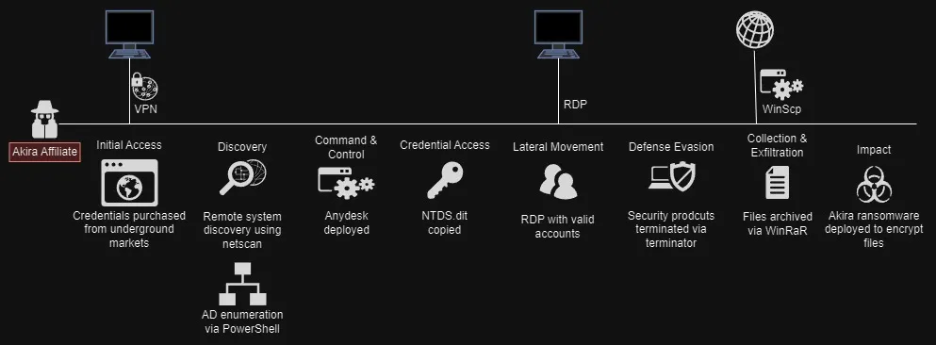
Akira primarily gains initial access via compromised remote-access infrastructure (VPN/SSL-VPN appliances, exposed RDP/SSH) and valid/stolen credentials; subsequent stages rely on remote-access tooling, credential harvesting, and network discovery to scale access rapidly and conduct double-extortion (exfiltration + encryption). Recent campaigns show a pronounced shift toward exploiting SonicWall SSL-VPN (Gen5/6/7/etc.) and other network-edge devices to achieve fast, high-impact intrusions.
Methods and Tactics:
Initial compromise post-compromise persistence:
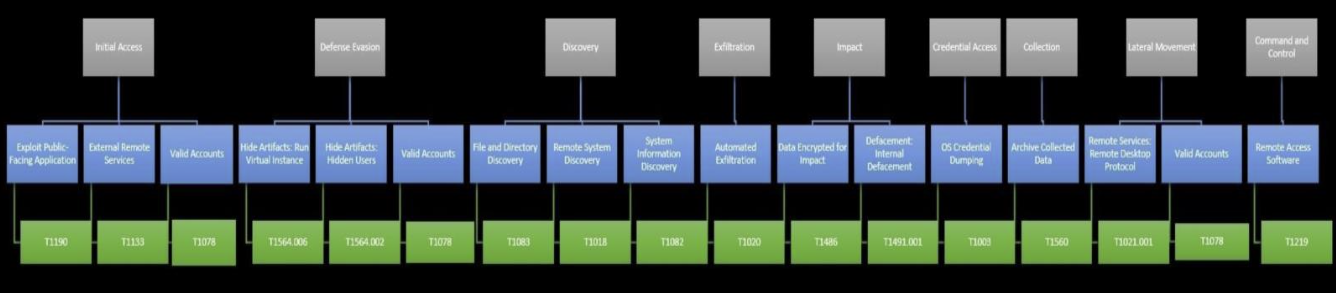
Attackers increasingly target exposed SSL-VPN web portals—such as SonicWall, Fortinet, Cisco ASA, and more recently WatchGuard—using automated scanners paired with credential-stuffing and brute-force tools to identify weak or reused passwords. They commonly exploit public-facing application vulnerabilities (T1190), leveraging known CVEs such as CVE-2023-20269, CVE-2022-40684, CVE-2024-40766, and occasionally chaining available zero-days to bypass authentication controls. Historically, Cisco ASA was the primary entry vector before late 2024, while SonicWall gained prominence after 2024 and WatchGuard entered attacker focus in 2025. When these exploits or stolen session tokens are successful, operators obtain VPN-range access and weaponize valid accounts (T1078) to pivot deeper inside internal networks. In cases where direct access fails or credentials are unavailable, they fall back on phishing campaigns or reused data from prior breaches to establish initial foothold.
Credential & MFA abuse:
Credential harvesting is commonly achieved through OS credential dumping (T1003) using memory and database dump techniques—frequently employing tools such as Mimikatz and similar frameworks, observed in more than 12.5% of investigated cases. Attackers additionally target backup-stored OTP seeds or misconfigured appliance export files to exploit credentials (T1558) and generate valid one-time passcodes offline. With these stolen credentials and OTP seeds, adversaries can bypass MFA protections and pivot through internal environments using legitimate privileged sessions, significantly reducing detection likelihood.
Discovery / lateral movement:
After gaining an internal foothold—often achieved through CVE-driven access—attackers conduct extensive network and account discovery (T1083 / T1018) using tools such as Netscan (31%), Advanced Port Scanner (25%), Advanced IP Scanner (12.5%), and AD enumeration utilities like SharpHound and AdFind to map internal assets and privilege paths. Lateral movement is then executed primarily through Remote Desktop Protocol (RDP) (T1021.001), SSH, and administrative tooling including PsExec, NetExec, and Impacket, frequently facilitated through remote services (T1133). Observable indicators include spikes in SMB/RDP session activity, unusual PsExec or remote service invocation patterns, and mass Active Directory query operations.
Exfiltration:
Targeted data is first archived and compressed (T1560) using tools such as WinRAR (62.5%) and 7-Zip (18.75%) to prepare large data sets for transfer. Exfiltration commonly occurs through dedicated transfer clients including WinSCP (31.25%), FileZilla (18.75%), Rclone (18.75%), and Bitvise SSH Client (6%), or through uploads to web-hosting platforms and cloud storage services. These activities align with exfiltration over C2 or cloud channels (T1041 / T1567), and are often followed by distribution via magnet or torrent links to complicate takedown and tracking. Typical detection indicators include unusually large outbound HTTPS sessions to cloud endpoints and the sudden appearance of large archive files within internal systems.
Encryption & impact:
Ransomware binaries spanning Windows PE, Linux, and ESXi modules are deployed broadly across compromised environments, with Akira operators heavily focusing on virtual infrastructure—impacting Hyper-V and Windows hosts in more than 43.75% of cases, VMware ESXi datastores in over 31.25%, and NAS systems in roughly 6.25%. Once staged, operators delete VSS snapshots, shut down virtual machines, and launch ESXi encryptors using switches such as -n, -p, and -fork, ultimately appending .akira extensions as files are encrypted for impact (T1486). Defensive controls are routinely neutralized, with frequent disabling or modification of security tools (T1562), including inhibition of Windows Defender in approximately 48.57% of observed incidents. Admin-level credentials exfiltrated via Veeam or other sources are then reused or reset to delay remediation and recovery efforts.
Negotiations:
-
Victims are instructed via the akira_readme.txt file to contact the group through a dedicated Dark Web chat portal, where Akira pressures them with time-limited offers, proof-of-decryption demonstrations, and threats to publish stolen data on their leak site. The group presents itself as offering fast and cost-effective recovery, using professional sounding "support" chats to exploit the victims' urgency and desperation.
-
In one case, Akira initially demanded $600,000 for full decryption assistance, data deletion evidence, and guarantees against data publication. After continued exchanges, the ransom amount was reduced to $200,000, which the victim ultimately paid in Bitcoin. Following payment, Akira provided deletion logs and decryption support, along with a brief post-incident advisory detailing how access was obtained and offering basic security recommendations to prevent future breaches.
Victimology:
Overview:
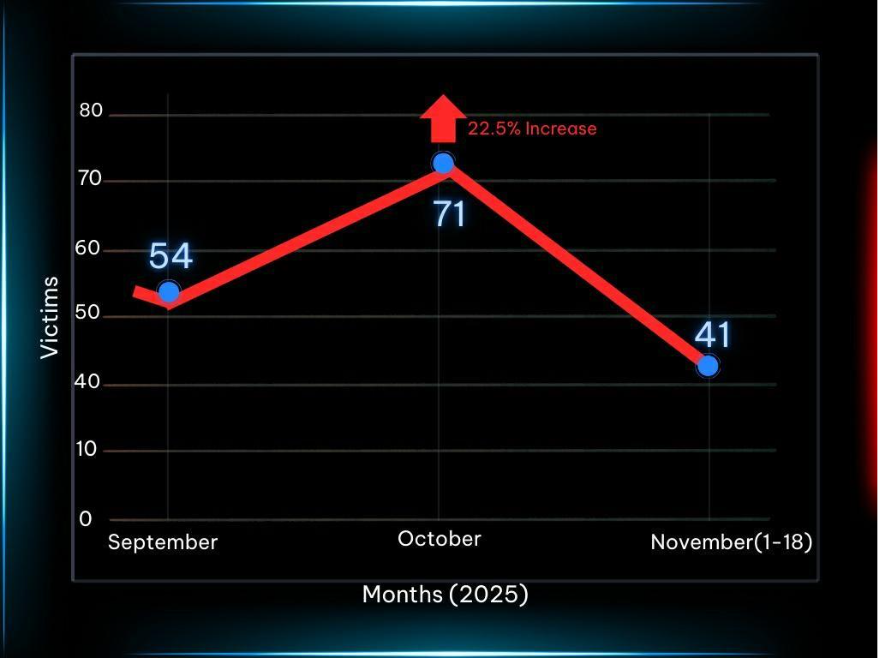
Since its emergence in March 2023, the Akira ransomware group has claimed responsibility for 1,113 confirmed victims worldwide, reaffirming its status as one of the most active and persistent ransomware operations to date. The group has maintained consistent activity throughout 2025, with a notable escalation during the final quarter. In September 2025, Akira recorded around 54 confirmed victims, rising to 71 in October, and 41 additional victims during the first eighteen days of November 2025. There was a 22.5% increase in the number of Akira ransomware victims in Sept–Oct compared to Jul–Aug. This sustained cadence of attacks underscores the group’s operational maturity and automation-driven affiliate structure.
Targeted Industries:
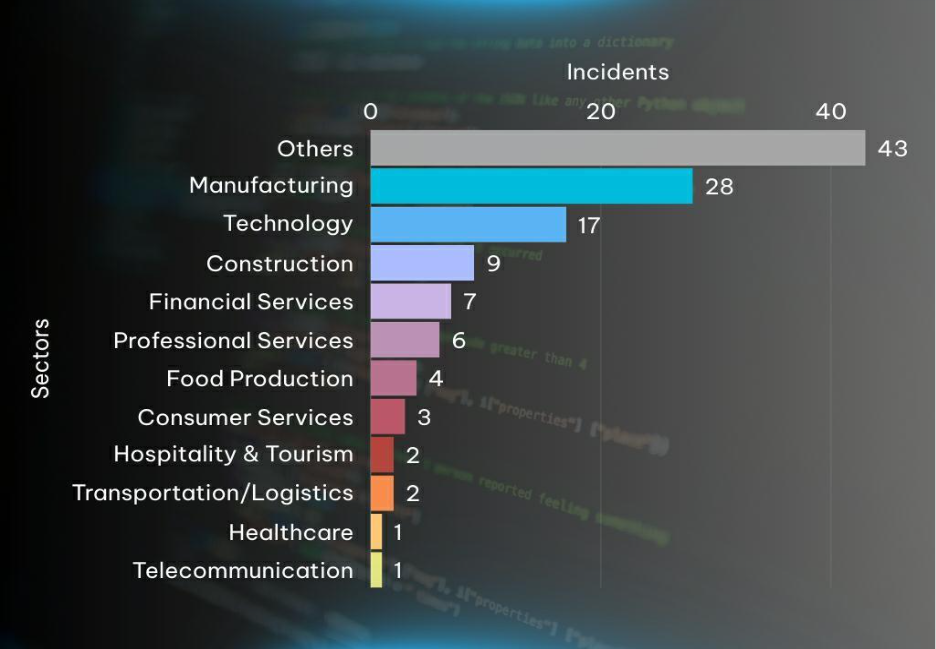
From a sectoral perspective, Akira’s ransomware attacks in September and October 2025 reveal a broad targeting strategy with emphasis on both operational and high-impact sectors. The manufacturing sector was the most affected, with 28 confirmed incidents. This was followed by the technology sector (17) and construction (9), highlighting the group’s interest in disrupting critical infrastructure and supply chains. Financial services (7) and business services (6) also featured prominently among the victims, reflecting Akira’s strategic focus on sectors where downtime can translate to sizable economic loss and bargaining power. Sectors such as agriculture and food production (4), consumer services (3), and transport & logistics (2) were also targeted, while healthcare (1) and telecommunications (1) saw comparatively lower activity. These patterns underscore Akira’s sustained drive to pressure organizations whose operations and data are central to their public and financial credibility.
Geographical Distribution:
Geographically, Akira’s operations in September and October 2025 continued to concentrate heavily in North America and Western Europe, with the United States being the epicenter of activity, accounting for the majority of incidents reported during this period. Other notable regions impacted include Canada, Germany, and the United Kingdom, although at significantly smaller scales. Incursions were also observed in countries like Denmark, Italy, and Spain, confirming Akira’s continued focus on digitally mature economies where the operational impact of downtime is high and organizations are more likely to engage in ransom negotiations. This geographic distribution highlights the group’s tactical alignment with maximizing monetization through attacks in regions with high data value and cyber insurance penetration.
Attack Arsenal:
-
Remote access: AnyDesk, Radmin, Rust Desk, TeamViewer and Mesh Agent are used as interactive post-compromise channels for GUI control and file transfer. OpenSSH, Ngrok and Cloudflare provide resilient reverse/forward tunnels so operators can maintain access despite perimeter changes.
-
Discovery: Masscan, Advanced IP Scanner and SoftPerfect NetScan are used for fast host/port discovery and network mapping. SharpHound/BloodHound and PowerView perform Active Directory enumeration to reveal privilege paths and high-value targets.
-
Credential harvesting: Mimikatz, LaZagne and DonPAPI extract credentials, Kerberos tickets and stored secrets from memory and local stores. Custom Veeam extraction scripts (e.g., VeeamHax-style tools) target backup managers to recover service credentials.
-
Lateral movement & execution: PsExec, Impacket (AtExec/NetExec) and CrackMapExec enable remote execution at scale using stolen credentials. RDP, SSH and MobaXterm provide hands-on interactive lateral control for staging and deployment.
-
Persistence: Attackers create local/domain accounts and install legitimate admin tools or services for long-term access. Scheduled tasks and service installers are used to re-establish remote-access tooling after reboots.
-
Defense evasion: PowerTool/KillAV utilities and Zemana driver abuse are used to stop AV/EDR processes; PowerShell scripts modify Defender settings and registry exclusions. Running noisy components inside internal VMs is also employed to reduce endpoint telemetry.
-
Collection & exfiltration: WinRAR and 7-Zip compress harvested data into archives for efficient transfer. WinSCP, FileZilla, Bitvise, RClone and MEGA are used to move data offsite (with occasional torrent/magnet publishing for persistence).
-
Offensive frameworks & payloads: Cobalt Strike is used for covert C2 when required; CrackMapExec and ReconFTW automate large-scale post-exploitation tasks. Observed payload names include akira.exe, lock.exe, w.exe and megazord.exe, typically deployed via remote execution or GPO.
MITRE TTPs:
IOCs:
MD5
c7ae7f5becb7cf94aa107ddc1caf4b03
431d61e95586c03461552d134ca54d16
af95fbcf9da33352655f3c2bab3397e2
d25890a2e967a17ff3dad8a70bfdd832
e44eb48c7f72ffac5af3c7a37bf80587
302f76897e4e5c8c98a52a38c4c98443
e57340a208ac9d95a1f015a5d6d98b94
e8139b0bc60a930586cf3af6fa5ea573
a1f4931992bf05e9bff4b173c15cab15
08bd63480cd313d2e219448ac28f72cd
4aecef9ddc8d07b82a6902b27f051f34
ab9e577334aeb060ac402598098e13b9
SHA256
26d5748ffe6bd95e3fee6ce184d388a1a681006dc23a0f08d53c083c593c193b
8b9c7d2554fe315199fae656448dc193accbec162d4afff3f204ce2346507a8a
d0c1662ce239e4d288048c0e3324ec52962f6ddda77da0cb7af9c1d9c2f1e2eb
a1a6005cc3eb66063ae33f769fc2d335487b2ed7f92c161e49ad013ffed11ec8
1a70f4eef11fbecb721b9bab1c9ff43a8c4cd7b2cafef08c033c77070c6fe069
fc5f82f45745385d8c0dc82caf2ad5695b1addfbf556d1e72d792835876574ce
bd2c2cf0631d881ed382817afcce2b093f4e412ffb170a719e2762f250abfea4
e1fefa948907a18fb0bc7717da9d4272e93bf9707413e9689ab8f053af4c7924
fdd00e1bf19fe207b1ca7dbee50816ff85e53eaad9deb5e5b8fef92210fb6bc0
3c92bfc71004340ebc00146ced294bc94f49f6a5e212016ac05e7d10fcb3312c
1d3b5c650533d13c81e325972a912e3ff8776e36e18bca966dae50735f8ab296
1d3b5c650533d13c81e325972a912e3ff8776e36e18bca966dae50735f8ab296
3c92bfc71004340ebc00146ced294bc94f49f6a5e212016ac05e7d10fcb3312c
Conclusion:
The Akira ransomware operation represents a mature, profit-driven Ransomware-as-a-Service (RaaS) model that continues to expand its victim base. Negotiating with Akira or similar ransomware operators remains highly discouraged, as payments neither guarantee data recovery nor protect against data leaks. Each ransom payment sustains the broader RaaS ecosystem, enabling threat actors to fund development and expand their operations. Ultimately, the Akira campaign underscores a critical truth: organizations must invest in layered defense, early detection, and resilient recovery processes rather than rely on ransom negotiations or reactive containment.
Strategic Recommendations:
Overview:
A “defend, detect, and recover” framework rooted in patched systems, layered defenses, offline backups, and user awareness remains the most effective strategy against RaaS-driven attacks.
-
Harden and Monitor VPN / Gateway Infrastructure: Immediately patch or segment all Cisco ASA, SonicWall, and WatchGuard SSLVPN appliances to eliminate known vulnerabilities. Enforce Multi-Factor Authentication (MFA) across all VPN and remote-access endpoints, ensuring strong authentication against unauthorized access. Additionally, activate continuous monitoring of gateway logs to detect brute-force attempts and credential spraying activity in real-time.
-
Backup and Virtualization Systems (Veeam / ESXi / Hyper-V): Apply critical updates and patches to Veeam Backup & Replication instances to mitigate vulnerabilities such as CVE-2023-27532 and CVE-2024-40711. Backup servers should be administratively isolated from the production domain, with strict access controls enforced. Regular credential audits should also be conducted to remove plaintext or cached passwords from backup configuration files, reducing exploitation potential.
-
Strengthen Email & User Awareness: Attackers gain initial access by exploiting user behavior. It's critical to enforce a strict policy preventing employees from interacting with suspicious emails, links, or attachments. Regular training on phishing and social engineering should be a mainstay of your security posture as human error remains a prime attack vector.
-
Enforce Credential Hygiene & Strong Authentication: Ensure all users apply unique, complex passwords and rotate them regularly—ideally 1–2 times per month. Prevent password reuse across services, and enforce Multi-Factor Authentication (MFA) wherever possible to reduce unauthorized access risk.
-
System & Software Hardening: Maintain the latest versions of operating systems and update all software promptly to reduce exploitability. Implement antivirus and traffic monitoring solutions to detect malicious indicators and block unauthorized or unexpected activity across endpoints and network layers.
-
Secure Remote Access & VPN Management: For VPN access, establish a separate jump host with unique credentials that differ from Active Directory/domain accounts. This segmentation helps contain credential abuse. Monitor VPN traffic closely and enforce MFA to step up access control.
-
Backup Resilience & Recovery Preparedness: Utilize cloud-based backup solutions that support token-based authentication to prevent unauthorized access. Ensure backups are isolated from production networks and regularly verify recovery integrity to support ransomware resilience.
-
Defense-Aware Operations & Policy: Document and enforce a clear cyber hygiene policy, emphasizing regular user training and accountability. Regularly audit administrative and remote-access privileges under Zero Trust principles. Encourage a culture of security ownership and continuous vigilance across all roles — especially system and network administrators.
By reinforcing these core practices — rooted in human vigilance, credential protection, remote access security, and system hygiene — organizations can vastly reduce their exposure to ransomware and related breaches, even when attackers come prepared with insider knowledge of the environment.